For: Busy IELTS learners who are unsure what to study next
A daily IELTS study plan should remove decisions
A daily IELTS study plan is useful when it tells you what to do before your study time begins. You should not spend the first ten minutes opening different videos, books, and practice pages. A clear plan gives each session one skill, one task, and one review action.
This makes a short session feel complete and helps you see what to practise next.
The plan does not need to fill every free hour. IELTS preparation includes four language skills, but steady work is usually more sustainable than a crowded timetable. This guide gives you a seven-step weekly rhythm that can fit around work, study, and family life.
It is a planning framework, not an official IELTS programme, and it cannot promise a particular score.
Step 1: confirm your test type and purpose
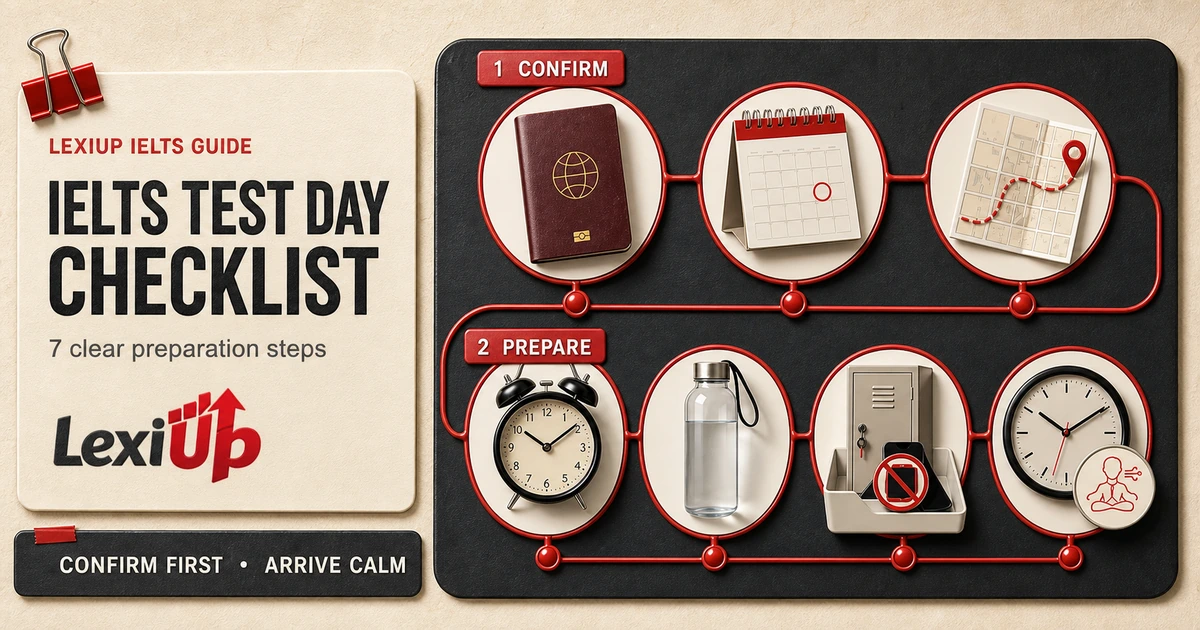
Start with the requirement from the organisation that will receive your result. IELTS Academic and General Training share the same Listening and Speaking tests, but Reading and Writing differ. Academic is commonly used for higher education and professional registration. General Training is commonly used for migration, work experience, and study below degree level.
The receiving organisation decides which test it accepts.
Write your test type at the top of the plan and use matching official practice materials. This small check prevents you from spending time on the wrong Reading passages or the wrong Writing Task 1 format. If you have not confirmed the requirement, contact the organisation before you build a detailed schedule.
- Record whether you need IELTS Academic or General Training.
- Check whether the organisation requires a particular result or test date.
- Use official materials that match your test type.
- Keep Listening and Speaking practice in the plan for either test type.
Step 2: choose a realistic amount of weekly time
Look at a normal week, not an unusually quiet one. Mark the periods you can protect most often. These may be twenty minutes before work, a lunch break, or a longer session on the weekend. Leave travel, meals, rest, and other responsibilities visible. A plan that ignores your real life is difficult to repeat.
Choose a minimum session you can complete on a busy day and a longer checkpoint for a less crowded day. For example, a minimum session might be fifteen focused minutes, while the weekly checkpoint might be forty or sixty minutes. The purpose of the minimum is continuity. The purpose of the checkpoint is to practise pacing and concentration.
Step 3: give every session one clear job
A session becomes easier to start when its job is specific. “Study Reading” is broad. “Complete one matching-headings set, check every answer, and record one timing problem” is clear. The task should include an attempt, correction, and a small next action. Watching an explanation can help, but it should not replace active practice every day.
Keep the materials ready before the session. Save the official question, open the correct LexiUp practice area, or place the notebook on your desk. Removing small setup decisions protects the limited attention you have after a long day.
- Choose one main skill or question type.
- Complete one focused attempt without checking the answer early.
- Review why each wrong answer was wrong.
- Save one mistake, useful phrase, or follow-up task.
- Write the first action for the next session.
Step 4: build a balanced seven-day rhythm
A balanced week touches all four skills while giving extra attention to a confirmed weaker area. Do not label a skill as weak only because you have not practised it recently. Missing evidence means you need a short checkpoint. Repeated problems across several attempts give you a better reason to add focused practice.
The example below uses five focused sessions, one checkpoint, and one flex or rest day. Move the days to match your life. You can also combine a short vocabulary or grammar review with a main skill, but keep the primary job clear.
| Day | Main job | Review action |
|---|---|---|
| Day 1 | Reading question type practice | Record one instruction or evidence error. |
| Day 2 | Listening section practice | Check spelling, plurals, and word limits. |
| Day 3 | Writing planning and one paragraph | Review the paragraph against one criterion. |
| Day 4 | Speaking recording on one topic | Notice one clarity or fluency pattern. |
| Day 5 | Confirmed weaker skill | Repeat a similar but new task. |
| Day 6 | Timed checkpoint or fuller response | Choose one priority for the next week. |
| Day 7 | Flex day, light review, or rest | Move one missed task here only if useful. |
Step 5: turn correction into the next practice task
Checking an answer is not the end of a session. Name the reason for the result. A Reading error may come from a missed instruction, weak location strategy, or unsupported inference. A Listening error may come from spelling, a distractor, or losing your place.
A Writing or Speaking problem may involve task response, organisation, vocabulary, grammar, pronunciation, or development.
Write the reason in plain language and create a near-transfer task. If you exceeded a word limit, practise another completion set and read the instruction first. If a paragraph had an unclear main idea, rewrite that paragraph and then plan a new one.
This connects review to action instead of building a long list of corrections you never revisit.
Step 6: use one flex day for calm recovery
A missed day should not erase the week. Keep one day partly open so you can move an important task without doubling the next session. If the flex day arrives and you are on track, use it for a light review or take a proper rest. Recovery is part of a sustainable plan, not a failure of discipline.
When several sessions are missed, restart with the smallest complete task. Do not try to repay every minute. Check whether the original schedule was realistic, then reduce the number or length of sessions if needed. A plan is a tool you adjust using evidence from your week.
Step 7: review the plan once a week
At the end of the week, look for patterns rather than judging yourself. Which sessions were easy to start? Which task took longer than expected? Did the same error return? Did you avoid one skill because the task was unclear? Use those answers to change the next week in one or two small ways.
LexiUp IELTS can help you keep practice, correction, and review connected on iPhone. Choose a relevant practice area, complete a focused attempt, and return to saved mistakes or feedback when you plan the next session. LexiUp is an independent preparation app, and its estimates are not official IELTS band scores.
Use it as one practical part of a plan grounded in official test information.
- Keep the time and days that worked.
- Shorten or move sessions that repeatedly failed to fit.
- Add practice for a repeated, confirmed problem.
- Use a checkpoint when evidence about a skill is missing.
- Carry only the most useful unfinished task into the new week.
Frequently asked questions
How long should I study for IELTS each day?
There is no single official daily length. Choose a repeatable minimum session and one longer weekly checkpoint. A focused attempt with correction is more useful than a longer session with no clear task.
Should I practise every IELTS skill every day?
Not necessarily. A weekly plan can rotate Reading, Listening, Writing, and Speaking while giving extra time to a confirmed weaker area. Keep all four skills visible across the week.
What should I do if I miss a study day?
Resume with one small complete task or use a planned flex day. Do not double the next session automatically. Adjust the timetable if missed sessions show that the original plan was too crowded.
Can LexiUp tell me my official IELTS band score?
No. LexiUp is an independent preparation app. Its practice guidance and estimates can support study decisions, but they are not official IELTS examiner scores.
Sources and review note
This guide was reviewed against the sources below. LexiUp remains independent of the exam owners.