For: Academic and General Training learners sitting on a reported overall 6.5 who need 7.5 for a visa, a licence or a university offer, and who are about to spend a month studying the skill they enjoy rather than the one that would move the result
IELTS 6.5 to 7.5 is 2.5 band points, not four
Almost everyone plans this jump wrong, and the reason is arithmetic rather than effort. Moving from IELTS 6.5 to 7.5 looks like a full band in every skill, so it reads as four separate mountains. It is not.
The overall band is the average of the four skill bands, so what you actually need is a bigger total, and the total you are missing is usually much smaller than it feels.
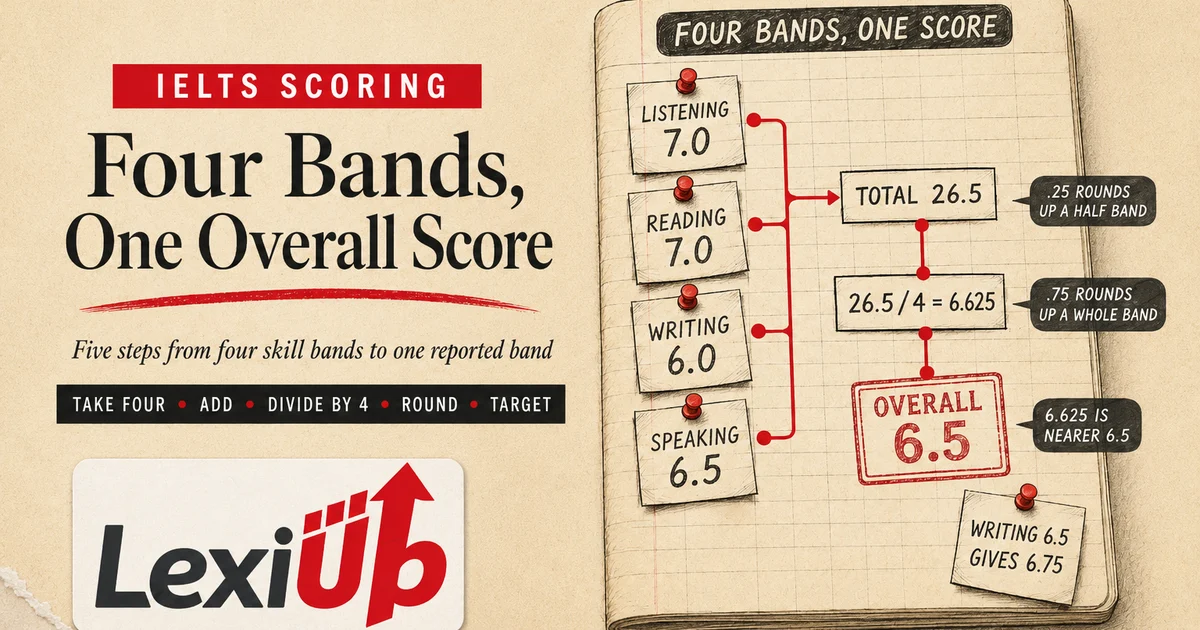
Work it through. A reported 6.5 can come from four bands totalling anywhere between about 25 and 28.9. Take a common shape: Listening 7.5, Reading 6.5, Writing 6.0 and Speaking 6.5. That totals 26.5, which averages 6.625, and 6.625 sits nearer 6.5 than 7.0, so the Test Report Form reads 6.5.
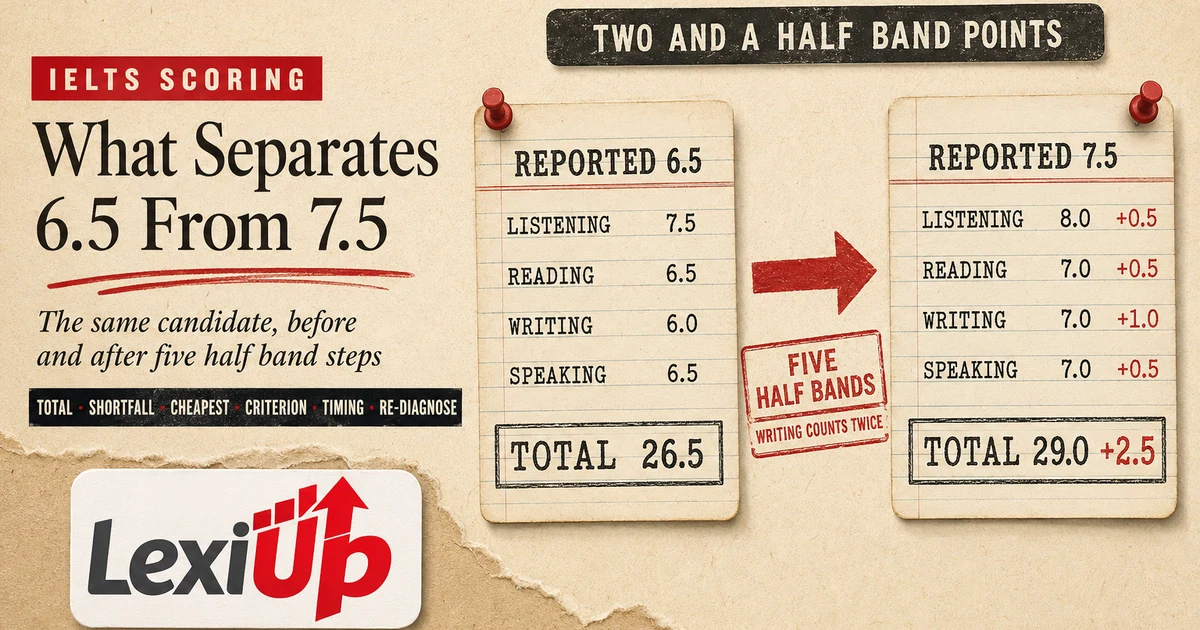
Now aim at 7.5. An average of 7.25 is reported as 7.5, because the published rule rounds an average ending in .25 up to the next half band. An average of 7.25 needs a total of 29.0. From 26.5 to 29.0 is two and a half band points, spread across four skills, in half band steps.
That is five half bands to find, not four whole ones, and it is a completely different plan.
Two candidates on the same overall band, different distances to go
Here is an original worked comparison written for this article. Two candidates open their results and both read overall 6.5. They are not in the same position, and neither of them can see it from the front of the form.
Candidate A scored Listening 7.5, Reading 6.5, Writing 6.0, Speaking 6.5. Total 26.5, average 6.625, reported 6.5. Candidate B scored Listening 6.0, Reading 6.5, Writing 6.5, Speaking 6.5. Total 25.5, average 6.375, also reported 6.5. Same headline number, but A is 2.5 band points from 7.5 and B is 3.5, a full band further away.
The distances differ, and so does the cheapest route. Candidate A needs five half band steps across four skills, which means one skill has to move a whole band, because a whole band is two steps on its own.
A whole band in Writing plus a half band in each of the other three finishes at Listening 8.0, Reading 7.0, Writing 7.0 and Speaking 7.0, a total of 29.0.
Four steps would not be enough, and it is worth seeing why. Four half bands added to 26.5 reaches 28.5, which averages 7.125, and 7.125 is nearer 7.0 than 7.5, so it is reported as 7.0. Getting to 7.5 from here therefore requires at least one full band somewhere.
Candidate B needs seven steps and should probably target 7.0 first. Two people with identical reported scores need different plans, and the only way to know which one you are is to add your four numbers rather than read the overall.
| Skill | Candidate A | Candidate B |
|---|---|---|
| Listening | 7.5 | 6.0 |
| Reading | 6.5 | 6.5 |
| Writing | 6.0 | 6.5 |
| Speaking | 6.5 | 6.5 |
| Total | 26.5 | 25.5 |
| Average, and reported band | 6.625, reported 6.5 | 6.375, reported 6.5 |
| Band points still needed for 29.0 | 2.5 | 3.5 |
Step 1: work out your total, then your shortfall
Write your four skill bands down and add them. That single number tells you more than the overall band does, because the overall band hides up to three and a half points of variation behind one printed figure. Then subtract your total from 29.0.
What is left is your shortfall, and it is the only number your study plan needs to reduce.
Do not round anything while you work. Averages ending in .25 and .75 round up by rule, and everything else goes to the nearest whole or half band, so a plan built on rounded intermediate numbers can be half a band wrong before you start. Keep the raw total until the very end.
Then write the shortfall as half band steps, because half bands are the unit you can actually buy. A shortfall of 2.5 is five steps. A shortfall of 3.5 is seven. Seeing it as steps rather than as a band makes it a shopping list rather than an ambition.
- Write down the four reported skill bands from your Test Report Form.
- Add them for a total between 0 and 36, keeping every half.
- Subtract that total from 29.0 to get your shortfall.
- Divide the shortfall by 0.5 to get the number of half band steps.
- Write the steps as a list, one line each, before choosing any of them.
Step 2: buy the cheapest half bands, not the ones you enjoy
Half bands are not equally priced. A Reading score two marks under a boundary is often a few weeks of technique. A Speaking band that needs a genuine fluency shift can be months.
Most candidates spend their preparation on the skill they find most satisfying, which is usually the one they are already best at, and that is the most expensive place to shop.
Rank your four skills by how close each is to its next half band, not by how much you like them. The skill sitting just under a boundary is cheap. The skill where you have never studied the criteria is usually cheap too, because the first pass at an unstudied criterion moves fastest.
The skill you have already polished twice is expensive, and a third polish rarely buys a step.
This is where the arithmetic pays off. Because the total is what matters, a half band is worth exactly the same to your overall band whichever skill it comes from. There is no bonus for improving your strongest skill and no penalty for improving your weakest. Buy the cheap ones.
- Recover Reading marks sitting just under a band boundary →
- Stop losing Listening marks you have already earned →
- Nearest to a boundary first, whatever skill it sits in.
- An unstudied criterion beats a third pass at a polished one.
- A half band counts the same from any of the four skills.
- Never plan around the skill you most enjoy practising.
- Re-rank after every practice test, because the order changes.
Step 3: treat Listening and Reading as the fastest points
Listening and Reading are marked objectively, forty questions each, one mark per correct answer and nothing deducted for a wrong one. That makes them the most predictable place to find a half band, because the distance to the next band is a countable number of marks rather than an examiner judgement.
It also makes the losses countable. Answers that were understood but written with a spelling or grammar error are marked wrong, as are answers that break the word limit. Those are marks you have already earned and then handed back, and recovering them requires no new comprehension at all.
For many candidates a half band is sitting in that pile.
Work out how many marks separate you from the next band, then find that many recoverable errors in your last two practice tests before adding any new material. Conversion figures vary between test versions and the tables in this guide are indicative teaching material rather than official ones, so check the official sources for current published figures.
Step 4: move Writing and Speaking one criterion at a time
Writing and Speaking are each assessed on four criteria of equal weight, so each skill band is itself an average. That is useful, because it means you never have to improve everything at once.
Lifting one criterion by a band lifts the skill band by a quarter of a band, and two criteria lift it by half, which is a whole step on your list.
Name the criterion before you practise. Task Response, Coherence and Cohesion, Lexical Resource, and Grammatical Range and Accuracy in Writing; Fluency and Coherence, Lexical Resource, Grammatical Range and Accuracy, and Pronunciation in Speaking. General advice to write better cannot be practised. A named criterion can, and it can be checked afterwards.
Pick the criterion you have never deliberately studied, not the one you already worry about. The one you worry about has usually had attention. The one you have never looked at is where the untouched quarter bands are, and it is almost always the cheaper of the two.
Steps 5 and 6: rehearse under real timing, then re-diagnose
Technique that only works with extra time is not yet worth a half band. Once a change is reliable in slow practice, rehearse it against the clock until it survives, because the version of you that sits the test is the timed one.
This is the step most plans skip, and it is why gains that appeared in practice fail to appear on the report form.
Then re-diagnose rather than continue. Sit a full practice test, add the four bands, subtract from 29.0, and see what the shortfall is now. The cheapest half band will usually have moved to a different skill, because you just bought the one that was cheapest.
A plan that does not get re-ranked keeps spending on a skill that stopped being the bargain weeks ago.
Expect the last half band to be the slow one. Going from IELTS 6.5 to 7.5 is rarely a smooth climb: the first two steps often come quickly from recovered marks and an unstudied criterion, and the final step takes as long as the first four together. Budget for that rather than reading it as failure.
- Practise the change slowly until it is reliable.
- Repeat it against the real clock until it survives the timing.
- Sit a full practice test with no pauses.
- Add the four bands and subtract from 29.0 again.
- Re-rank the four skills and buy the next cheapest step.
Practise the IELTS 6.5 to 7.5 jump inside a weekly routine
Turn the shortfall into a week that repeats. Two sessions on the cheapest skill, one session recovering marks you already know how to earn, one session on a single named criterion, and one full timed rehearsal.
Then re-add your four bands at the end of the week and decide the next week from the new numbers rather than the old plan.
Keep the arithmetic visible while you do it. Candidates who track a total rather than an overall band stop being surprised by the report form, because they can see a 28.5 coming and know it reads as 7.0 rather than 7.5.
That knowledge changes what you practise in the final fortnight, which is exactly when the cheapest remaining half band matters most.
LexiUp IELTS is built for this loop. It is free to start and, since version 1.0.10, entirely ad-free, and its AI feedback returns a criterion-by-criterion read on a Writing or Speaking attempt, so you can see which of the four criteria is holding a skill band down instead of guessing.
The free tier allows five successful AI feedback results in any rolling twenty-four hours. Its band guidance is an estimate meant to aim your practice, not an official IELTS examiner score.
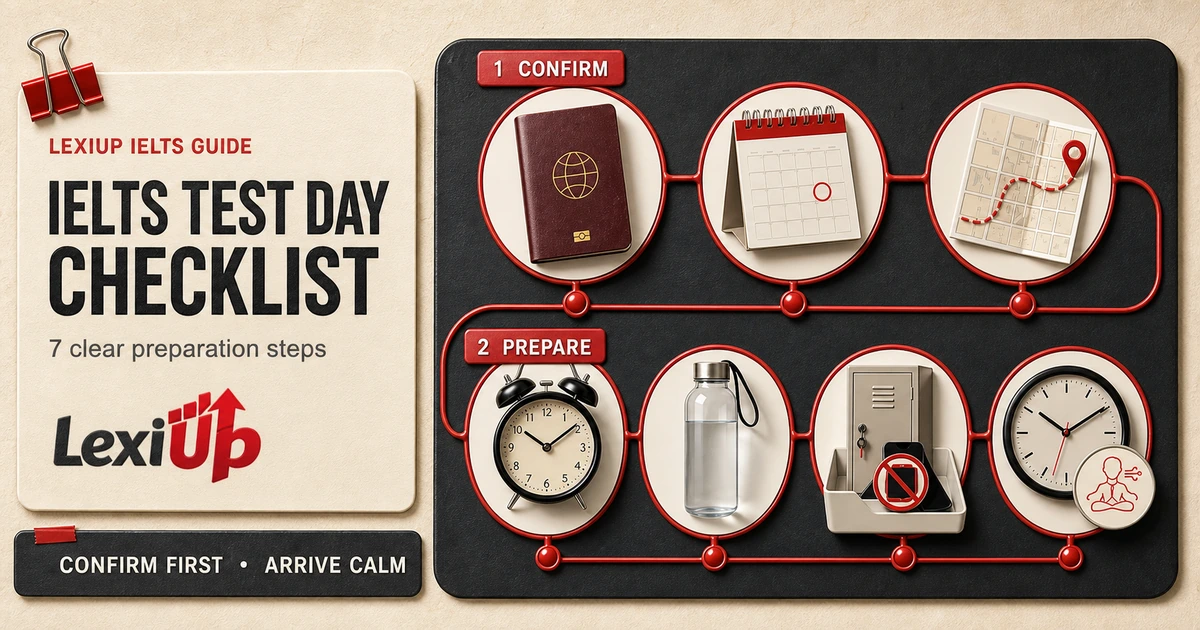
- Protect the score you have earned with the test day checklist →
- Rebuild the daily routine around your new shortfall →
| Session | Focus | Finish with |
|---|---|---|
| 1 and 2 | The cheapest skill on this week list | One technique that works slowly |
| 3 | Recovering marks already earned | A count of avoidable errors fixed |
| 4 | One named Writing or Speaking criterion | One criterion practised, not four |
| 5 | Full timed rehearsal | Four bands, added into a total |
| End of week | Re-diagnose | A new shortfall and a new cheapest skill |
Frequently asked questions
How many band points do I actually need to go from IELTS 6.5 to 7.5?
You need a four skill total of 29.0, because 29.0 divided by four is 7.25 and an average ending in .25 is rounded up to the next half band. If your current total is 26.5 the gap is 2.5 band points, which is five half band steps spread across four skills, not four separate whole band jumps.
Is it faster to improve my strongest skill or my weakest?
Neither, on principle. A half band adds the same amount to your total whichever skill it comes from, so the right choice is whichever is cheapest to move. That is usually the skill sitting closest to a boundary, or one where you have never studied the assessment criteria, and it is rarely the skill you enjoy practising most.
Can I reach 7.5 overall with one skill still at 6.5?
Yes. Bands of 8.0, 7.5, 7.0 and 6.5 total 29.0 and are reported as 7.5. The overall band only cares about the total, so a single lower skill is not fatal unless your institution sets a minimum for each skill separately, which many do. Check the requirement you are actually being held to before planning around the overall figure alone.
How long does the jump from 6.5 to 7.5 usually take?
It varies too much for a single honest answer, but the shape is predictable: early steps come faster than late ones. Recovered marks and a first pass at an unstudied criterion tend to move quickly, while the final half band commonly takes as long as everything before it. Plan in shortfall reduced rather than in weeks elapsed.
Should I aim straight at 7.5 or take 7.0 first?
If your total is below about 26 the gap to 29.0 is three and a half band points or more, and an intermediate target of 28.0, which reports as 7.0, keeps the plan measurable. Aiming at a target you can reach in one cycle and then re-diagnosing beats a long push at a number that stays out of sight for months.
Sources and review note
This guide was reviewed against the sources below. LexiUp remains independent of the exam owners.