For: IELTS learners who have the vocabulary and grammar they need but lose Fluency and Coherence marks to long silences, restarted sentences, word searches, and answers that stop after one clause
IELTS Speaking fluency is measured as flow, not speed
IELTS Speaking fluency is not a measure of how quickly you talk. The public band descriptors for Fluency and Coherence describe speaking at length, keeping going without noticeable effort, and connecting ideas so a listener can follow them. Speed is not mentioned anywhere.
A fast answer full of restarts sits below a steady answer that moves cleanly from one idea to the next, because the examiner is listening for flow and organisation rather than words per minute.
That distinction matters because most learners repair the wrong thing. They practise talking faster, and the extra speed produces more false starts, more self-correction, and more sentences that collapse halfway through. The examiner hears effort. Meanwhile the real causes go untouched: hunting for a rare word, planning an entire sentence before beginning it, and abandoning a structure mid-clause.
Those habits return the moment the topic is unfamiliar, which on test day is most of the time.
This guide sets out six practical drills and one original worked answer. The cue card, the learner lines, and the repairs below were written as teaching material for this article. They are not real test questions and they are not official examiner responses.
Use official IELTS, British Council, IDP, and Cambridge materials for current format and assessment information, and use the drills here to build habits that survive nerves.
Hear an original worked answer repaired line by line
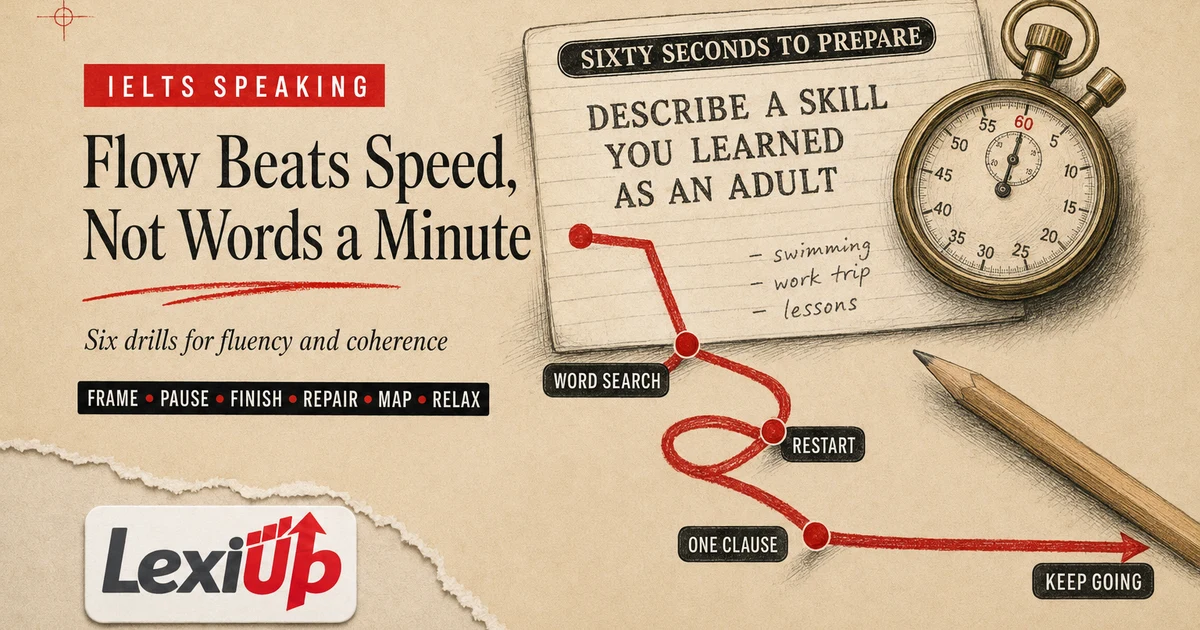
Here is the original teaching cue card written for this article: Describe a skill you learned as an adult. The prompts ask what the skill was, why you decided to learn it, how you learned it, and how useful it has been.
Given one minute to prepare, a learner wrote four words on the note paper, swimming, work trip, lessons, useful, and then produced an answer that stalled three separate times inside the first thirty seconds.
The stalled version, also written for this article, ran roughly like this. So the skill I learned, um, it was, I learned swimming. Actually no, not swimming exactly, I mean, how do you say, adult swimming lessons. And the reason, the reason was because, um, because of a work trip, yeah. Nothing there is a vocabulary problem.
The speaker already knows every word the answer needs. It breaks because each sentence is being planned in full before it is spoken.
The repaired version uses the same four notes and the same vocabulary. The skill I learned as an adult is swimming, proper lessons, in my thirties. I decided to learn because of a work trip, actually.
My team went to a coastal office for a week, there was a beach day planned, and I realised I would have to sit and watch. Same content, no restarts, and the ideas arrive in the order the speaker genuinely thought of them.
| What the speaker did | Why it cost fluency | The repair |
|---|---|---|
| Searched for the exact phrase | Silence while adult swimming lessons was retrieved | Say the simple word first and add the precise one afterwards. |
| Corrected a word that was already right | Actually no, not swimming exactly undid a correct answer | Leave a good enough word in place and keep moving forward. |
| Planned the whole reason before speaking | The reason, the reason was because repeated three times | Open with a frame and find the content while already talking. |
| Ended on a single clause | Because of a work trip, yeah left the examiner nothing to follow | Add one consequence sentence so the idea finishes itself. |
Drill 1: open with a frame so the first word is never the hard one
Most hesitation happens at the start of a sentence, because that is the moment you are deciding what the whole sentence will be. A frame removes the decision. Frames are short, content free openings you already own: the main reason is, what happened was, I suppose the honest answer is, for me personally.
You begin speaking on autopilot, and the content assembles itself during the two seconds the frame buys you.
This is not padding and it is not memorised material pretending to be thought. A frame is one clause long and is followed immediately by something specific. The failure mode is the opposite habit, a learner who has memorised a whole paragraph of introduction and delivers it before every answer.
Examiners recognise rehearsed language quickly and it does not lift a fluency score. Keep about six frames, rotate them, and treat each one as a runway rather than a destination.
- Keep roughly six short frames and rehearse them until they need no thought.
- Start speaking on the frame while the content is still forming.
- Follow every frame within one clause with real, specific detail.
- Rotate frames so the same opening does not begin every answer.
- Never grow a frame into a memorised paragraph the examiner has heard before.
Drill 2: replace silent pauses with spoken ones
A silent pause and a spoken pause cost very different amounts. Silence reads as breakdown, because the listener waits and the effort becomes audible. A spoken pause, such as well, let me think, or that is something I have never really considered, keeps the channel open and signals that an answer is on its way.
Both take the same two seconds. Only one of them sounds like a speaker who is in control of the conversation.
The working rule is one spoken pause per answer, near the beginning, and never two in succession. Used more heavily the habit becomes its own problem, and an answer scattered with you know and sort of sounds evasive rather than fluent.
Choose two or three natural expressions, use them where you genuinely need a moment to think, and let the rest of the answer run on ordinary connected speech.
- Record a two minute answer and mark every pause longer than two seconds.
- Decide which pauses were thinking time and which were word searches.
- Assign one spoken pause to the longest thinking gap.
- Re-record the same answer using that single spoken pause.
- Compare the two recordings for audible effort rather than for speed.
Drill 3: finish every idea with one reason and one example
Short answers are a fluency problem even when every word in them is correct. A reply that stops after one clause forces the examiner to ask another question, and the criterion about speaking at length never collects its evidence. The repair is mechanical rather than creative: after your opening statement, add one reason, then one concrete example.
Two extra sentences turn a five second reply into a twenty second one without inventing any new ideas.
Concrete detail beats general detail every time. Because it is useful is a reason the examiner has heard in every interview that week. Because I could not swim and my team had already planned a beach day is the same reason with a place, a group, and a consequence attached.
Specific detail does not only score better, it is easier to produce, because you are remembering something that happened rather than composing an argument while speaking.
- State the answer itself in one clear sentence first.
- Add one reason that explains the statement instead of repeating it.
- Add one concrete example with a place, a person, a time, or a number.
- Stop once the example lands rather than restating the opening.
- Use the same two move pattern in Part 1 and in Part 3.
Drill 4: repair forwards instead of restarting
Self-correction is explicitly part of what Fluency and Coherence describes, and the expensive kind is the restart: abandoning a sentence and beginning it again from the first word. Every restart erases the progress already made and doubles the effort the listener hears.
Most restarts are triggered by a small error the examiner had already understood, and would have cost almost nothing if the speaker had simply carried on.
Repairing forwards means attaching the correction to the end of the sentence rather than rewinding to its start. If you say went where you meant have been, continue and let the following sentence carry the right tense. If a word is imprecise, follow it with or rather and the better word.
The sentence stays alive, the meaning stays clear, and you have demonstrated repair, which is a fluency skill, instead of demonstrating collapse.
Drill 5: practise against a clock, never against a script
Fluency is a timing skill, so it needs timed practice. Set ninety seconds, choose an ordinary topic, and speak until the timer stops, allowing yourself to be repetitive and imperfect. The single rule is that you do not stop.
That trains the exact ability the test measures, which is continuing to produce connected language while the content is still being assembled somewhere behind it.
Writing the answer out first destroys the drill. A scripted answer trains recall, and recall fails the moment the question is phrased slightly differently, leaving a longer silence than if you had never scripted anything at all. Notes are fine, four words on a page as in the worked example above. Sentences are not.
If you can read your preparation aloud, you are rehearsing a text rather than building IELTS Speaking fluency.
- Choose an ordinary topic and allow yourself fifteen seconds of notes.
- Write no more than five single words, and never a full sentence.
- Speak for ninety seconds without stopping, however repetitive it becomes.
- Record every attempt so the pauses can be counted afterwards.
- Repeat the topic once, then change topics rather than polishing one answer.
Drill 6: count one hesitation type at a time
Listening back to a recording and concluding that it sounded hesitant changes nothing at all. Counting does. Play a two minute answer and count one thing only: the number of restarts, or the number of pauses longer than two seconds, or the number of times you said um.
One number, one recording, written down where you will see it again next week.
In the next session, run the same drill and count the same thing. A restart count falling from nine to five is visible progress that a general impression would never have revealed, and it tells you when the habit is repaired and the next one deserves the time.
Counting everything at once produces a page of notes and no change, because attention divided across five habits repairs none of them properly.
| Hesitation type | What to count | The repair to practise |
|---|---|---|
| Silent pause | Gaps longer than two seconds | One spoken pause near the start of the answer. |
| Restart | Sentences abandoned and begun again | Repair forwards and let the next sentence carry the fix. |
| Word search | Audible hunts for one precise word | Say the simple word, then upgrade it afterwards. |
| Short answer | Replies that end after a single clause | Add one reason and one concrete example. |
| Filler overload | Uses of um, you know, and sort of | Cap spoken pauses at one per answer. |
Build a hesitation map from your IELTS Speaking fluency practice
After a week of drills, put the counts side by side instead of keeping a folder of recordings you will never replay. Five rows, one per hesitation type, and one short column per session. The map shows which habit is genuinely costing you marks, and it is rarely the one that felt worst at the time.
Word searches feel humiliating and cost two seconds; answers that stop after one clause feel fine and cost an entire criterion.
The pattern also tells you when to stop. A restart count that has been flat for three sessions means that drill has done its work and the next hesitation type deserves the practice time.
This kind of preparation rewards short, frequent, narrow work far more than long undirected conversation, because each habit being repaired is small, specific, and mechanical rather than a general question of confidence.
Practise out loud between full mock tests
LexiUp IELTS gives this narrow, repeated kind of practice somewhere to live between full mock tests. It is free to start and has been ad-free since version 1.0.10, so a ninety second timed round is never broken partway through at the moment you were about to keep going.
Its AI feedback returns up to five successful results in any rolling twenty-four hours, which suits the one count per session rhythm above rather than encouraging a single long undirected sitting.
Two limits belong in plain sight. LexiUp IELTS is an independent preparation app rather than an official IELTS service, and the band estimates it produces are practice guidance, not examiner scores.
Treat them as a direction of travel between recordings, use the drills to decide what to repair next, and rely on the official sources below for anything concerning test format, booking, or how speaking is actually assessed.
Keep the routine small on test day
The examiner is a person having a conversation with you, and these drills work best when they stay invisible. Use a frame if the first word will not come. Use one spoken pause when you genuinely need to think. Add a reason and an example when an answer feels thin. Repair forwards when something comes out wrong.
That is four small rehearsed habits, none of which requires you to recall a technique while under pressure.
If an answer goes badly, let it finish and start the next one cleanly. A single weak response matters far less than the pattern across a fourteen minute conversation, and learners routinely lose more marks recovering from one poor answer than they lost by giving it.
Speak at a comfortable pace, finish your sentences, and let the preparation do the work it was built to do.
Frequently asked questions
Does speaking faster improve my IELTS Speaking fluency score?
No. The Fluency and Coherence descriptors describe speaking at length and keeping going without noticeable effort, not speed. Extra speed usually adds false starts and self-correction, which are exactly the features that make effort audible to an examiner.
Are fillers such as um and you know penalised?
Not in themselves, and a natural spoken pause is better than silence. The problem is volume. Used once near the start of an answer a filler buys thinking time; scattered through every sentence it starts to sound like hesitation rather than natural speech.
Is self-correction always bad in IELTS Speaking?
No, and it is named in the criteria. A brief forward repair, such as adding or rather and a better word, shows control. What costs marks is abandoning a sentence and restarting it from the beginning, because that erases the progress the listener has already followed.
How long should a Part 1 answer be?
Long enough to show connected speech, which usually means a statement, a reason, and a short example. One clause is too short to demonstrate anything. A speech lasting a minute is too long for Part 1 and takes time away from the questions that follow.
Sources and review note
This guide was reviewed against the sources below. LexiUp remains independent of the exam owners.