For: IELTS Academic and General Training learners whose opening Speaking answers are either one word long or a memorised speech, and who want a repeatable way to sound natural in the first four minutes of the test
Use IELTS Speaking Part 1 to sound natural, not rehearsed
IELTS Speaking Part 1 is the opening stage of the Speaking test. The examiner confirms your identity, then asks familiar questions about your home, your work or studies, and two or three everyday topics such as food, weather, music, or travel. The questions are ordinary on purpose. They are not testing your opinions or your general knowledge.
They are checking whether you can talk about normal life clearly and comfortably without preparing anything first.
Two habits cost marks in this stage. The first is the bare answer: yes, no, or a single noun, which gives the examiner almost no language to assess. The second is the memorised answer, where a rehearsed paragraph arrives for a simple question and the delivery becomes flat, over-formal, or slightly off-topic.
Both habits are easy to hear, and both are avoidable with one repeatable answer shape.
This guide gives six practical steps and one original worked example. The example question and answers were written as teaching material for this guide. They are not real test questions and they are not official answers.
The aim is one flexible routine you can apply to any familiar topic during focused practice, so the opening minutes of the test feel like a normal conversation.
See one bare answer grow into a complete reply
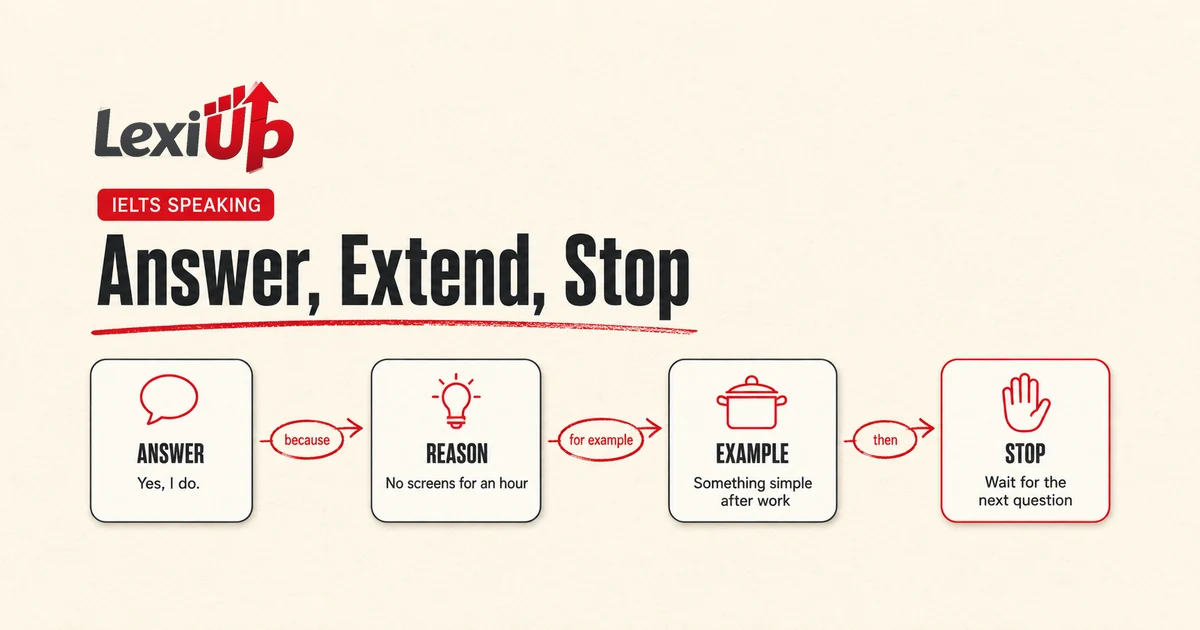
Take one familiar question: do you enjoy cooking? The bare version is a single word. Yes. It is accurate, it answers the question, and it ends immediately. The examiner now has one word of language to assess and has to ask another question straight away. Nothing about that reply is wrong, but nothing about it shows range either.
The second layer answers directly and then gives one reason. Yes, I do, mainly because it is the part of the day when I stop looking at a screen. The reply is still short, but it now contains a personal reason, a linking word, and a natural rhythm.
This is already enough for most questions in the opening stage.
The third layer adds one small example, and the fourth layer stops. I usually cook something simple after work, like a rice dish my mother taught me. Then the answer finishes. There is no summary sentence, no second topic, and no attempt to fill silence.
The examiner moves on, which is exactly what should happen in this stage of the test.
| Layer | What you say | What it shows |
|---|---|---|
| Direct answer | Yes, I do. | You understood the question |
| One reason | Mainly because it is when I stop looking at a screen. | Natural linking and personal detail |
| One example | I usually cook something simple after work. | Range without a rehearsed speech |
| Full stop | Silence, and the next question. | Control, not drifting |
Step 1: hear which everyday topic the question opens
The opening questions arrive in small groups. The examiner asks about you, then about one familiar topic, then about another. Each group has a theme, and the questions inside it usually move from simple fact to preference to a small comparison.
Hearing the theme early tells you which vocabulary you are about to need for the next minute of speech.
Listen for the topic noun and the question word together. Do you often listen to music? The topic noun is music, and the question word do points to your general habit. What kind of music do you like? The same topic continues, but the request has moved to preference.
Tracking that movement stops you from repeating the identical answer twice.
Do not plan a speech from the theme. Planning a paragraph while the examiner is still speaking is the fastest way to miss the actual question. Hold only the topic noun and the type of information requested. That is enough to choose the right vocabulary while still listening to every word of the question in front of you.
- Catch the topic noun: music, weather, food, travel, or study.
- Catch the question type: habit, preference, frequency, or reason.
- Notice when the same topic moves to a new request.
- Hold the topic, not a prepared paragraph.
Step 2: answer the question directly in your first sentence
Your first sentence should contain the answer, not an introduction to the answer. A direct opening proves you understood the question and gives the rest of your reply something to attach to. Openings such as well, that is a very interesting question delay the content, sound rehearsed, and add nothing an examiner can assess.
Match the grammar of the question in your reply. If the question begins with do you, answer with I do or I do not. If it begins with how often, answer with a frequency phrase such as most evenings or about twice a month. If it begins with what kind, name the kind first.
This simple matching keeps your answer accurate and easy to follow.
A direct answer can still be honest about uncertainty. Not really is a complete answer. It depends is a complete answer, as long as the next sentence says what it depends on. What matters is that the examiner hears your position immediately, rather than waiting through a wind-up that carries no information.
- Do you like it? Answer with I do, I do not, or not really.
- How often? Answer with a frequency phrase, not a story.
- What kind? Name the kind before explaining it.
- Why? Give the reason in the first clause.
- Skip every introduction phrase that carries no content.
Step 3: add one reason, example, or comparison
After the direct answer, extend it once. One extension is usually enough in this stage, and it should be the smallest natural next thing a person would say in conversation. Three extensions work reliably: a reason for your answer, a concrete example, or a short comparison with something else.
Reasons use because, since, or mainly. Examples use like, for instance, or a specific detail such as a place, a time, or a person. Comparisons use more than, whereas, or used to. Choosing one of the three before you speak prevents the pause that happens when a reply ends and you are still deciding what comes next.
Keep the extension personal and specific. A general statement such as it is good for health could belong to anyone and gives the examiner nothing to work with.
A specific detail such as I walk to the market on Saturday mornings shows real vocabulary in use, and specific detail is also far easier to say fluently than an abstract idea.
- Give the direct answer first.
- Choose one extension: reason, example, or comparison.
- Make it specific with a place, time, person, or number.
- Say it in one sentence, not three.
Step 4: stop after two or three sentences
Knowing when to finish is a real skill in this stage. Two or three sentences answer a familiar question completely. Beyond that, most answers begin to repeat, wander into a second topic, or become a small speech the examiner has to interrupt. The opening stage is a set of short exchanges, not a series of long turns.
Stopping cleanly also protects your accuracy. Long unplanned answers are where tense slips, missing articles, and abandoned sentences appear, because you are inventing structure while speaking. A short answer that finishes on a complete sentence sounds more controlled than a long one that fades out with and things like that.
Silence after a complete answer is not a problem. The examiner has a scripted set of questions and will move on immediately. Treat the end of your answer as a handover rather than an empty space you must fill, and the whole exchange starts to feel like a conversation instead of a performance.
| Signal | Sounds like | What to do next |
|---|---|---|
| Answer complete | Direct reply plus one extension | Stop and wait |
| Starting to repeat | Saying the same reason again | Stop mid-idea and wait |
| New topic appearing | Moving from food to family | Stop before the shift |
| Filler arriving | And stuff like that | End on the last full sentence |
Step 5: match the tense the question asks for
Familiar questions move quietly between time frames, and the tense is the part most learners drop under pressure. A question about what you usually do needs a present habit. A question about your childhood needs a past form. A question about your plans needs a future form.
The topic can stay the same while the required tense changes twice in a row.
Use the question as your model. Did you enjoy reading when you were younger becomes I did, I read a lot of comics. Will you keep doing it becomes I probably will, or I am planning to.
Reusing the auxiliary from the question is a fast, low-effort way to start in the correct time frame before you add your own content.
When you notice a tense slip, repair it briefly and continue. A short self-correction such as I go, sorry, I went is normal in speech and is far better than restarting the whole answer. Stopping to rebuild a sentence from the beginning costs fluency, and fluency and coherence is one of the four criteria used to assess Speaking.
- Usually, generally, these days: present simple habit.
- When you were a child, last year: past forms.
- Are you going to, will you: future forms.
- Have you ever: present perfect, then past detail.
- Repair a slip in three words and keep speaking.
Step 6: recover in one breath when your mind goes blank
Sometimes a familiar question about a familiar topic produces nothing. This is normal, and it is recoverable, because the topics are everyday ones and there is no correct answer to find. What matters is that the recovery is short and honest rather than a long silence or an invented story that you cannot finish.
Say something true about the question itself, then answer. I have never really thought about it, but I suppose I would say yes. That opening buys about two seconds, sounds natural, and moves straight into content. It works far better than repeating the question back word for word, which fills time without adding language.
You can also ask for one repetition. Sorry, could you say that again is a normal request and the examiner will repeat the question. Ask once when you genuinely did not hear it, then answer the question you heard. Asking repeatedly, or asking what a word means, turns a small gap into a longer interruption.
- Take one breath instead of filling the pause with sound.
- Say one honest sentence about the question.
- Give any reasonable answer; there is no correct opinion.
- Ask for a single repetition only when you did not hear it.
Practise IELTS Speaking Part 1 answers in a weekly routine
Short practice repeated across a week beats one long session. On day one, practise direct first sentences only. On day two, add a single reason to each answer. On day three, add one specific example. On day four, work on stopping cleanly after two or three sentences.
On day five, record a mixed set of familiar questions and review one target.
Review with evidence rather than a score. Play the recording back and mark one moment where the answer started late, one where it ran too long, and one where the tense slipped. Fix a single target in the next attempt.
A practice session that produces one observable change is more useful than one that produces a general feeling about your speaking.
LexiUp IELTS keeps short speaking sessions attached to a daily plan and a later review on iPhone, so a target you set at the start of the week is still in front of you at the end of it. The app is free to start and supports independent preparation.
Its guidance and estimates are not official IELTS examiner scores. Use official IELTS, British Council, IDP, and Cambridge materials for current format and assessment information.
| Day | Practice focus | Finish with |
|---|---|---|
| 1 | Direct first sentences | Ten answers that start with content |
| 2 | One reason | Ten answers with because or mainly |
| 3 | One example | Ten answers with a specific detail |
| 4 | Stopping cleanly | Ten answers that end on a full sentence |
| 5 | Record and review | One evidence note and one retry |
Frequently asked questions
How long is IELTS Speaking Part 1?
Public IELTS materials describe the opening stage as roughly four to five minutes of identity checks and familiar questions, inside a Speaking test of about eleven to fourteen minutes in total.
How long should each answer be?
Two or three sentences answer a familiar question completely. A direct reply plus one reason or example is enough, and stopping there keeps your accuracy and control intact.
Can I ask the examiner to repeat a question?
Yes. Asking once for a repetition is normal. The examiner works from a script, so expect the same question again rather than an explanation, and then answer what you heard.
Are the opening topics different for Academic and General Training?
No. The Speaking test is the same for both Academic and General Training candidates. Only Reading and Writing differ between the two versions of the test.
Should I memorise IELTS Speaking Part 1 answers?
No. Memorised replies are easy to hear, often miss the exact question, and collapse when the topic shifts. Practise the answer shape instead, then apply it to fresh questions.
Sources and review note
This guide was reviewed against the sources below. LexiUp remains independent of the exam owners.