For: Academic and General Training learners who can write fluent paragraphs but lose Task Response marks by discussing when they were asked to decide, listing when they were asked to weigh, or answering only half of a two-part question
IELTS Writing Task 2 essay types are set by the instruction line
Most Task 2 marks are lost before a sentence is written, at the moment a learner decides what the essay is about instead of what it has to do. The topic gives you the subject. The instruction line gives you the job.
IELTS Writing Task 2 essay types are separated by that instruction line alone, and two questions built on an identical subject can demand completely different essays. Reading the topic first is the habit that produces a fluent, well-organised answer to a question nobody asked.
Task Response is one of the four criteria the essay is marked against, and it asks whether you answered the question that was set, fully, with a clear position where one is required. Misreading the instruction damages that criterion directly, and accurate grammar cannot repair it.
An essay that discusses both views when the question asked how far you agree has not partly answered the task. It has answered a different one.
This guide sets out five types, the wording that signals each, and the paragraph plan each one forces. Section two takes a single topic and writes five original questions from it, so the plan changes while the subject stays still. Those questions and plans are teaching material written for this article.
They are not real test questions and they are not official answers, so use the official sources listed at the end for current format and assessment information.
Plan five original questions written from one topic
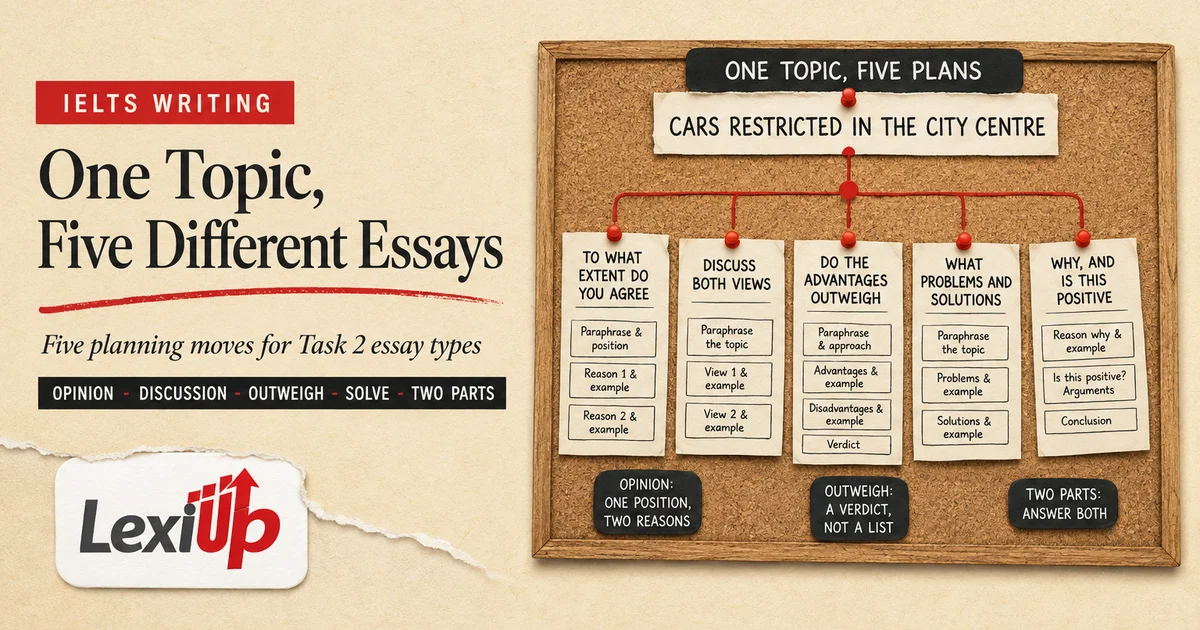
Here is the original teaching topic written for this article: in many cities, private cars are being restricted in the centre. Nothing in that sentence tells you what to write. Below it sit five instruction lines, each an original question written for this article.
Read them in order and watch the required essay change shape while the subject does not move at all.
Now read the second column against the third. Every one of those essays concerns the same cars and the same city centre, and the ideas you would gather for them overlap almost entirely.
What changes is the shape: how many positions you hold, whether your own opinion is required, whether ideas must be paired with each other, and whether the final body paragraph delivers a verdict or a second half of an answer. That shape is decided by the instruction line, before a single idea is chosen.
| Instruction line | Type | What the essay must contain |
|---|---|---|
| To what extent do you agree that restricting cars improves city life? | Opinion | One position, held from the introduction to the conclusion, supported by two developed reasons. |
| Discuss both views and give your own opinion. | Discussion | One body paragraph for each view, stated fairly, plus your own opinion made explicit. |
| Do the advantages of restricting cars outweigh the disadvantages? | Advantages and disadvantages | Both sides presented and an explicit verdict on which one is greater. |
| What problems does restricting cars cause, and how could they be solved? | Problem and solution | Named problems, each paired with a solution that addresses that problem specifically. |
| Why are cities restricting cars, and is this a positive development? | Two-part question | A direct answer to each question, with roughly equal space given to both. |
Type 1: opinion essays ask how far you agree
The signal wording is to what extent do you agree or disagree, or do you agree or disagree. The question asks for your position and nothing else. The most common failure is treating it as an invitation to survey the debate: one paragraph of arguments for, one paragraph against, and a conclusion that finally picks a side.
That essay never takes a position early, so the position is not clear throughout, which is exactly what the criterion asks for.
To what extent is a real part of the question. You may agree completely, or agree with a stated limit, and a partial position is not a weak one provided it is stated plainly and held.
What loses marks is a position that drifts: an introduction that agrees, a second body paragraph that quietly concedes the opposite, and a conclusion that lands somewhere new. Decide the extent before planning, write it in the introduction, and let both body paragraphs serve it.
- State your position in one sentence before planning anything else.
- Choose two reasons that support that position, not two sides of the debate.
- Give each reason its own paragraph, with an example that belongs to that reason.
- If you concede a limit, concede it inside a paragraph that still supports your position.
- Restate the same position in the conclusion, in different words.
Type 2: discussion essays need both views and your own
The signal wording is discuss both views and give your own opinion. This type has two obligations, and the second is the one that gets dropped under time pressure. Both views must be presented fairly, and your own opinion must appear as a stated position rather than an implication left for the examiner to infer.
A conclusion reading both sides have merit answers only half the question, however well the two views were explained.
Fairness matters more than it appears. A discussion essay that presents one view in four sentences and the other in one has not really discussed both, and an examiner reading the shorter paragraph will see a view mentioned rather than developed. Give the view you disagree with genuine reasons before you answer it.
Your own opinion can share a body paragraph with the view it supports, or take a short paragraph of its own, provided it is unmistakable.
- Write both views as full sentences before deciding which you support.
- Give each view its own paragraph and comparable development.
- State your opinion in the introduction so it is visible from the start.
- Explain why you hold it, rather than repeating the view you agree with.
- Close by restating your position, not by declaring the debate balanced.
Type 3: advantages and disadvantages need a verdict
The wording splits into two questions that look alike and are not. Discuss the advantages and disadvantages asks for a balanced account. Do the advantages outweigh the disadvantages asks you to weigh them and declare a result.
Outweigh is the word to hunt for, because it converts a list into a judgement, and an essay that describes both sides without answering it has left the actual question unanswered.
Weighing is not counting. Three advantages against two disadvantages proves nothing, and examiners are not persuaded by arithmetic. A verdict is earned by explaining why one side matters more: it affects more people, it lasts longer, it is harder to reverse, or it undermines the other side.
Name the reason your verdict rests on, and the conclusion writes itself instead of restating a list nobody needed twice.
- Underline outweigh, or its absence, before planning.
- If the word is there, decide your verdict first and plan towards it.
- Support the verdict with a reason of scale, duration, or reversibility.
- Keep both sides present: a verdict with one side missing is not a verdict.
- Never settle it by counting points on each side.
Type 4: problems must be matched to their own solutions
The wording asks what problems, causes, or challenges arise, and what could be done about them. The structural trap is a paragraph of problems followed by a paragraph of solutions that answer none of them. Pairing is the whole task.
Two problems, each followed immediately by the solution that addresses it, produces a coherent essay; four problems and three unrelated solutions produce a list that reads as unfinished thinking.
Depth beats coverage here. Two problems developed properly, each with a cause, a consequence, and a realistic response, will outscore five problems named in a sentence apiece. Check that each solution is plausible and connected: if the problem is that deliveries become difficult, the solution must address deliveries, not general public transport funding.
A solution that does not touch its problem is the most common reason this type reads as off-task.
- Name two problems specific enough to solve.
- Write the solution beside each problem before you start the essay.
- Check each pair aloud: does this fix that?
- Give each pair one body paragraph, problem first, solution second.
- Add the consequence of the problem so the solution has something to earn.
Type 5: two-part questions lose marks when half is missed
Two-part questions ask two things joined by and: why is this happening, and is it a positive development; what are the causes, and what effects follow. Both parts are equally weighted, and answering one thoroughly while the other receives a single clause is the definitive way to cap Task Response.
The safest plan is mechanical: one body paragraph per part, planned before writing so neither can be crowded out.
These questions hide in plain sight because the first half often reads like a complete essay prompt on its own. A learner who plans from the first clause writes a strong, focused answer to half a question. Underlining both verbs before planning takes seconds and prevents the single most expensive structural error in the whole task.
Count the question marks and the verbs, and make sure your plan has an answer for each.
- Underline every question verb in the prompt before planning.
- Write a one-line answer to each part before choosing examples.
- Give each part its own body paragraph and comparable length.
- Answer the evaluative half directly: positive, negative, or positive with a limit.
- Check the conclusion touches both parts, not only the second.
Read the instruction line twice before you plan
Nearly every misidentification comes from a small set of near-miss wordings, and each has a repair that costs seconds. The table below names the ones that appear most often in practice review, with the question that catches each.
Reading the instruction line twice, once for the topic and once for the verb, is the cheapest habit in the whole task and it prevents the error that no later revision can undo.
One warning about memorised structures. Learners who have drilled a four-paragraph template often force every question into it, and the template quietly overrides the instruction. A discussion template applied to an opinion question produces a balanced essay with no clear position; an opinion template applied to a two-part question drops a part entirely.
Templates help with timing and cohesion, but the instruction line chooses the shape, not the template you practised most.
| Wording | Often mistaken for | The question that catches it |
|---|---|---|
| Discuss the advantages and disadvantages | A verdict question | Does the word outweigh appear anywhere? |
| To what extent do you agree | A discussion question | Am I asked for both views, or only mine? |
| Discuss both views and give your own opinion | A balanced discussion | Have I stated my own position outright? |
| Why ... and is this a positive development | A single causes question | How many question verbs did I underline? |
| What are the causes and what solutions | A list of problems | Is each solution attached to one named problem? |
How IELTS Writing Task 2 essay types change the paragraph plan
Once the type is identified, the paragraph plan follows from it rather than from the topic. The IELTS Writing Task 2 essay types below share an introduction and a conclusion; what differs is the work the two body paragraphs do and what the conclusion has to deliver.
Learning these five shapes replaces planning with recognition, which is what buys back time on test day for developing ideas rather than deciding a structure.
The introduction is the same length in all five: paraphrase the statement, then state what this essay will do. Where the types differ is whether that second sentence carries a position. Opinion, discussion, and outweigh questions all need one in the introduction.
Problem and solution and two-part questions do not, because their answer is delivered by the body rather than announced in advance.
| Type | Body 1 | Body 2 | Conclusion delivers |
|---|---|---|---|
| Opinion | First reason for your position | Second reason for the same position | The same position, restated |
| Discussion | View one, fairly developed | View two, plus your opinion | Your position, not a balance |
| Advantages and disadvantages | The stronger side, with why | The weaker side, acknowledged | An explicit verdict |
| Problem and solution | Problem one and its solution | Problem two and its solution | A short summary of both pairs |
| Two-part question | A full answer to part one | A full answer to part two | A brief answer to both parts |
Review your practice essays by type, not by band
A self-assigned band on a practice essay teaches almost nothing, because the number hides the cause. Sorting your essays by which of the IELTS Writing Task 2 essay types they answered will show something a band score cannot: most learners are consistently weaker at one or two shapes.
Discussion essays lose the stated opinion; outweigh questions lose the verdict; two-part questions lose a part. The pattern is usually stable and usually invisible until the essays are grouped.
Once the weak type is identified, drill the plan rather than the essay. Write introductions and paragraph plans for six questions of that type in the time one full essay would take, and check only whether the shape is right: is the position stated, is the verdict explicit, is every part answered.
Six plans build recognition six times faster than one essay, and recognition is the skill that was actually missing.
- Build the correction habit with the IELTS mistake review guide →
- Score your own drafts more honestly with the Writing Task 2 practice review guide →
- Group your last ten practice essays by question type.
- For each, mark only whether the required shape was delivered.
- Find the type with the most structural misses.
- Write six plans of that type without writing full essays.
- Return to a full essay of that type only once the plans are consistently right.
Practise identification in short planning sets
Recognition improves through many short attempts rather than a few long ones, which makes it awkward to fit around full timed essays.
LexiUp IELTS is free to start and has been ad-free since version 1.0.10, so a ten minute planning set runs from the first question to the last without an interruption arriving while you are deciding whether a prompt wants a verdict or a discussion.
Its AI feedback returns up to five successful results in any rolling twenty-four hours, which suits one focused set a day.
Two limits belong in plain sight. LexiUp IELTS is an independent preparation app rather than an official IELTS service, and any band estimate it gives is practice guidance, not an examiner score.
Use it to check whether the type you were missing last week has stopped slipping, and rely on the official sources below for anything concerning task format, question wording, or how Writing is actually assessed.
Keep the routine small on test day
Under pressure the whole method compresses into three questions worth rehearsing in that short form. What is the instruction verb? How many things am I being asked for? Does this question want a position, a verdict, a pairing, or two answers?
Thirty seconds spent there decides the shape of forty minutes of writing, and none of it requires recalling a technique while the clock runs.
If a prompt genuinely looks like two types at once, choose the reading that requires more and write that. An essay containing a clear position and a fair account of both views satisfies an opinion question and a discussion question; an essay containing only one of those satisfies just one.
Covering the stricter reading costs a sentence or two and protects against the misidentification that would otherwise cap the criterion.
Frequently asked questions
How many IELTS Writing Task 2 essay types are there?
Five shapes cover almost every question: opinion, discussion, advantages and disadvantages, problem and solution, and two-part questions. Some are worded in more than one way, and a prompt can occasionally blend two. Learn the instruction wording rather than a fixed count, because the wording is what decides the plan.
What is the difference between an opinion essay and a discussion essay?
An opinion question asks only for your position and how far you hold it. A discussion question asks you to present both views fairly and then state your own opinion as well. Giving both views to an opinion question weakens the clear position the criterion expects, and omitting your opinion from a discussion question leaves half of it unanswered.
Do I have to give my own opinion in every Task 2 essay?
No. Opinion, discussion, and outweigh questions require a stated position. Problem and solution questions usually do not, and forcing one in can crowd out the pairing the question actually wants. Let the instruction line decide, and when it asks for your view, state it plainly rather than implying it.
What happens if I answer only one part of a two-part question?
Task Response is capped, because the task was not fully addressed. Both parts carry equal weight, so a strong answer to one half cannot compensate for a missing second half. Underline every question verb before planning and give each part its own body paragraph.
Can I use the same essay structure for every question?
No. A single memorised template will fit some questions and misrepresent others, and it tends to override the instruction line without you noticing. Keep the introduction and conclusion habits constant, and let the two body paragraphs change shape according to the type in front of you.
Sources and review note
This guide was reviewed against the sources below. LexiUp remains independent of the exam owners.