
For: IELTS learners practising Writing Task 2
An IELTS Writing Task 2 practice review needs a clear purpose
An IELTS Writing Task 2 practice review should do more than count grammar mistakes. Its purpose is to discover which decision most limited the response and turn that finding into a better next attempt. Begin with the exact prompt, then examine the essay through the four official assessment criteria.
Finish by rewriting one useful part and applying the lesson to fresh practice.
Official IELTS guidance explains that Task 2 asks for a response to a point of view, argument, or problem in at least 250 words. The response is assessed for Task Response, Coherence and Cohesion, Lexical Resource, and Grammatical Range and Accuracy. This guide uses those criteria as review lenses. It does not calculate an official band score.
Step 1: place the full prompt beside your answer
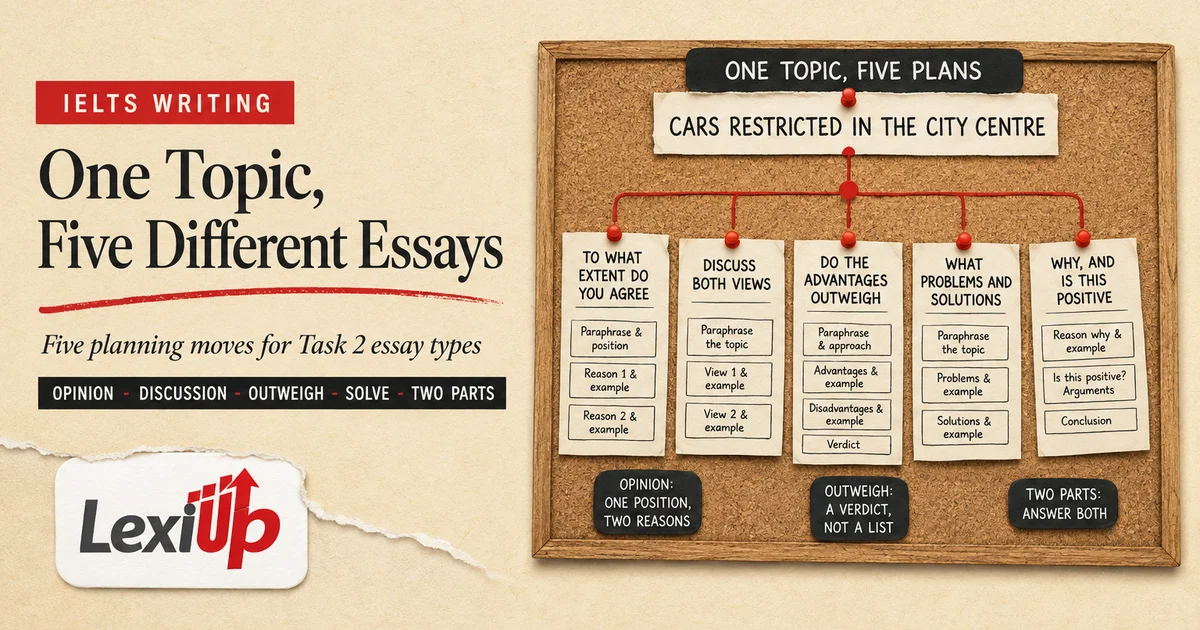
Read the prompt again before reading the essay. Mark every instruction: the topic, the question type, any groups or conditions, and each separate part you must answer. A response can contain clear English but still be incomplete if it discusses the broad topic and misses one direct question.
Task Response comes first because the other qualities cannot replace a missing answer.
Write a short checklist using your own words. For example, it might say “discuss both views + give my opinion” or “causes + solutions”. Then find where each requirement appears in the introduction, body, and conclusion. If one part is absent or much less developed, record that as a primary review finding.
- Did the introduction present a clear answer or position?
- Did every body paragraph help answer the exact task?
- Were the main ideas explained and supported?
- Did the conclusion reflect the same position without adding a new idea?
Step 2: review one criterion at a time
Do not try to inspect everything in one fast read. Use four passes. On the first pass, look only at Task Response. On the second, follow paragraph purpose and sentence order. On the third, notice vocabulary precision, repetition, spelling, and word formation. On the fourth, check sentence structure, punctuation, and your repeated grammar patterns.
Separate criteria because a sentence can have more than one issue. An unclear topic sentence may weaken organisation even if its grammar is correct. An ambitious word may weaken precision even if it is spelled correctly. Naming the problem accurately helps you choose a repair that matches it.
| Pass | Look for | Useful evidence |
|---|---|---|
| Task Response | Complete answer, clear position, relevant development | Missing prompt part, unsupported claim, general example |
| Coherence and Cohesion | Logical progression and purposeful paragraphs | Repeated point, unclear reference, mechanical connector |
| Lexical Resource | Accurate range, collocation, spelling and style | Forced synonym, vague noun, repeated word form error |
| Grammar | Controlled range and frequent accurate sentences | Sentence boundary, article, agreement or clause problem |
Step 3: choose one high-impact finding
A page covered in corrections can feel complete, but it often gives no clear direction. Choose the issue that most affected meaning, task completion, or organisation. “The second body paragraph does not explain why the example supports my position” is actionable. “My writing is bad” is not.
Keep smaller spelling or grammar notes, but do not let them hide the central weakness.
Look for repeated evidence. If one article error appears once, correct it. If it appears six times, it may deserve focused practice. If the position changes between the introduction and conclusion, that is likely more important than replacing one repeated adjective. The best priority is specific enough to practise and important enough to change the response.
Step 4: rewrite the smallest section that proves the repair
Rewrite one introduction, body paragraph, example, or conclusion. Do not copy the original sentence and change a few words. First state the new job of the section. Then write it again with the prompt and review finding visible. A focused rewrite keeps the lesson manageable and makes comparison easier.
If the problem was weak development, keep the same main idea but add a clear explanation and realistic support. If the problem was progression, change the order of sentences before adding linking words. If the problem was grammar, use a structure you can control and then create two new sentences with the same relationship.
- Name the exact review finding in one sentence.
- Choose the smallest section where the issue is visible.
- Write the section again without copying line by line.
- Compare the old and new versions against the relevant criterion.
- Record one rule to carry into the next task.
Step 5: test the lesson on a new prompt
A successful rewrite shows that you can improve with the answer beside you. A fresh prompt checks whether you can use the lesson independently. Within a day or two, plan or write a new paragraph that needs the same skill. Keep the topic different enough that you cannot memorise the previous wording.
For example, if you repaired an unsupported example, use a new question and practise point, explanation, and support again. If you repaired an unclear position, write three thesis statements for different question types. This near-transfer step turns feedback into a skill instead of a one-time correction.
Keep feedback grounded in the words you wrote
Useful feedback should point to visible evidence in the response. Ask what sentence, phrase, paragraph, or missing task part supports the comment. Be careful with broad statements that do not show where the issue appears. A teacher or qualified tutor can help you understand patterns that are difficult to see alone.
Automated guidance can support practice, but it should not be treated as an official examiner decision. Check suggestions against the prompt, official public descriptors, and your actual writing. Reject a correction that changes your intended meaning without explaining why.
Use LexiUp to connect practice, feedback, and rewrite
LexiUp IELTS can help you practise Writing on iPhone and keep the next repair task close to the original attempt. Use the IELTS Writing Task 2 practice review to choose one section, rewrite it, and revisit the pattern in later practice. Keep the official criteria beside you so the review remains connected to the real task.
LexiUp is an independent preparation app. Its AI feedback and estimates are not official IELTS scores, and they cannot promise a result. The useful conversion path is simple: learn the review method here, practise one relevant Writing task in the app, and carry one clear lesson into your next response.
Frequently asked questions
Should I correct every error in an IELTS Writing Task 2 review?
Correct clear errors, but also choose one high-impact pattern for focused repair. A long correction list is less useful if you do not know what to practise next.
Which IELTS Writing criterion should I review first?
Start with Task Response because the essay must answer the complete prompt. Then review organisation, vocabulary, and grammar separately.
Do I need to rewrite the whole essay?
Not every time. Rewriting the smallest section that proves the repair is often more focused. Write another full timed response when you need to test all skills together.
Can automated feedback give an official IELTS band?
No. Only IELTS examiners award official scores. Automated feedback can support practice when it is grounded in your writing and checked against official public criteria.
Sources and review note
This guide was reviewed against the sources below. LexiUp remains independent of the exam owners.