
For: PTE Academic and PTE Core learners who want a careful evidence-based method for a reading task where incorrect selections can lose points
What PTE Multiple Choice Multiple Answers asks you to do
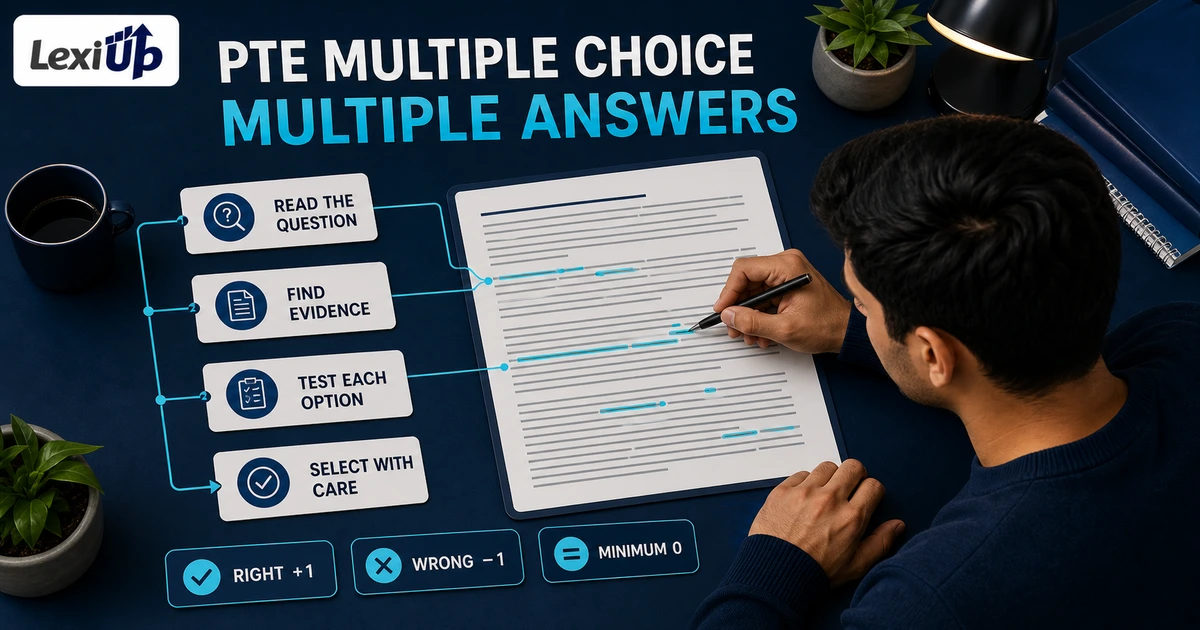
PTE Multiple Choice Multiple Answers is a Reading task in both PTE Academic and PTE Core. You read a passage, answer a question about its content or tone, and select more than one response. The task does not reward selecting everything that appears possible. It rewards finding every supported option while leaving unsupported options unselected.
Pearson currently states that each correct option earns one point and each incorrect option selected loses one point. The minimum score for the item is zero, so the deduction does not create a negative score for that item. This makes evidence more useful than confidence: every click needs a clear reason in the passage.
Academic passages can be up to 350 words, while Core passages can be up to 275 words. Neither task gives a separate item timer. You work inside the whole Reading section, so a repeatable method should be careful without becoming slow. The seven steps below organise that balance.
| Feature | PTE Academic | PTE Core | Practice decision |
|---|---|---|---|
| Task | Select more than one answer about content or tone | Select more than one answer about content or tone | Prove every selected option |
| Maximum passage length | Up to 350 words | Up to 275 words | Use question-led reading |
| Skill scored | Reading | Reading | Judge meaning, not surface word matches |
| Correct option | +1 | +1 | Select when the text supports it |
| Incorrect selected option | −1 | −1 | Leave it when evidence is missing |
| Minimum item score | 0 | 0 | Do not confuse the rule with a negative total |
Step 1: read the question before the passage
Read the question first and identify its exact job. It may ask which statements are supported, what the writer suggests, why something happened, or what tone the passage uses. Underline the decision word mentally: supported, main, reason, consequence, attitude, or inference. Similar-looking questions need different evidence.
Turn the question into a short search instruction. “Which statements does the passage support?” becomes “find claims the writer confirms.” “What can be inferred?” becomes “find conclusions that follow from more than one detail.” This small rewrite stops you from collecting interesting facts that do not answer the question.
Notice scope words such as mainly, likely, according to the passage, and all. A response can contain a true detail yet fail because it does not answer the requested scope. Keep the question visible while you read instead of trusting memory after a long passage.
Step 2: map the passage before judging options
Read for structure rather than trying to memorise every sentence. Give each paragraph a small role: topic, reason, example, contrast, result, limitation, or conclusion. A four-word note beside each paragraph is enough. The resulting map tells you where to return when an option makes a claim about the writer’s main point or supporting evidence.
Mark contrast and qualification carefully. Words such as however, although, only, may, and in some cases can reverse or limit a statement. An answer option often becomes wrong by removing one of these limits. “The change may help some learners” does not support “the change helps every learner.”
Do not begin by matching repeated words. Pearson recommends noticing repeated words to help locate relevant areas, but a shared noun is only a navigation clue. Read the surrounding sentence and its relationship to the paragraph before deciding whether the option preserves the meaning.
- Topic: what the paragraph is about.
- Claim: what the writer says about the topic.
- Support: the reason, example, or finding behind the claim.
- Limit: a contrast, condition, uncertainty, or exception.
Step 3: test each option as a separate claim
Judge one option at a time. Restate it in simple words, then point to the exact sentence or relationship that supports it. If the option combines two claims with and, both parts must be supported. One correct half does not rescue an unsupported second half.
Use three temporary labels: PROVED, DISPROVED, and NOT SHOWN. PROVED means the passage directly supports the option or makes the inference necessary. DISPROVED means the passage contradicts it. NOT SHOWN means the option may sound reasonable but the passage does not provide enough evidence. Only PROVED belongs in the final selection.
Be careful with outside knowledge. A familiar option can be true in the real world and still be wrong for this passage. The task measures how you analyse the text in front of you. Return to the wording and ask whether the writer, not your memory, supports the claim.
| Label | Evidence state | Action |
|---|---|---|
| PROVED | The passage directly supports the whole claim | Select |
| DISPROVED | The passage gives the opposite meaning | Leave unselected |
| NOT SHOWN | The claim is possible but not supported | Leave unselected |
| PARTLY TRUE | Only one part of a combined claim is supported | Leave unselected |
Step 4: recognise common distractor changes
Many distractors start with language from the passage and then change the relationship. They may reverse cause and result, turn an example into the main conclusion, replace a comparison with an absolute claim, or apply one group’s result to everyone. Familiar wording can therefore hide a different meaning.
Watch for strength changes. The passage may say can, may, sometimes, or tends to, while an option says always, proves, must, or only. A stronger claim needs stronger evidence. If the passage protects uncertainty, an absolute option is not an accurate paraphrase.
Also check who performed an action and when it happened. Options can swap the researcher and participant, an earlier condition and later result, or the writer’s view and a view merely reported. Build a quick subject–action–limit check before selecting.
- Compare the subject in the option with the subject in the passage.
- Compare cause, result, contrast, and sequence.
- Check every quantity and strength word.
- Confirm that an example has not become the main claim.
Step 5: manage the point deduction calmly
The scoring rule should change your evidence standard, not create panic. A correct option adds one point and an incorrect selected option subtracts one point, with zero as the minimum for the item. Selecting an option without passage evidence can therefore cancel value from a correct choice.
Do not create a fixed rule such as “always choose two.” Pearson says more than one response is correct, but the number can vary. Select the options you can prove. Leave an option unselected when its support depends on a guess, outside knowledge, or only one matching keyword.
Use confidence only as a final signal, not as proof. If you feel uncertain, return to the relevant paragraph and look for the subject, relationship, and limit. A clear contradiction or missing link is a reason to leave the option. A vague feeling is a reason to check again once, then move on.
Step 6: use a two-pass answer routine
On the first pass, select only options with direct, complete support. On the second pass, review unselected options that require inference. Ask whether the conclusion must follow from the passage or merely could be true. This separates strong evidence from attractive possibility.
Then compare your selected options with one another. Two options may use similar wording but make different claims. Both can be correct, one can be a narrower restatement, or one can introduce an unsupported limit. Do not deselect a proven option only because another answer sounds similar.
Finish with a deduction check: point to evidence for every selected option. If you cannot find it quickly, remove the selection unless the logical connection is necessary and clear. This last check is short because the earlier passage map tells you where the evidence should be.
- Practise PTE Reorder Paragraph with cohesion clues →
- Review PTE Reading and Writing Fill in the Blanks →
- Select direct support first.
- Review necessary inferences second.
- Compare similar options without assuming only one can be correct.
- Point to evidence for every final selection.
Step 7: review mistakes by decision type
After practice, do not record only the answer key. Record why each wrong decision happened. Did you misunderstand the question, miss a contrast, accept a partly true option, use outside knowledge, or select without evidence? A decision label gives the next session one specific target.
Keep the passage and options original or from authorised preparation material. Do not collect recalled live-test content. Build fresh practice by using short educational passages and writing several claims: one direct paraphrase, one supported inference, one reversed relationship, one overstatement, and one detail outside the text.
Revisit the same decision type with a new passage after one or two days. If you missed an overstatement today, practise strength words next time. If you relied on keyword matching, force yourself to write the subject and relationship before choosing. This delayed transfer shows whether the correction became a usable reading habit.
- Question error: answered a different question from the one asked.
- Meaning error: changed cause, contrast, sequence, or scope.
- Evidence error: accepted a claim not shown in the passage.
- Selection error: clicked despite incomplete support.
- Process error: spent too long without returning to the question.
A short practice session you can repeat
Use one unfamiliar passage and four to six original options. Spend one minute reading the question and mapping paragraph roles. Test each option with PROVED, DISPROVED, or NOT SHOWN, then make the final selection. The exact time can change with passage length; the important point is to complete the full evidence cycle.
Review every option, including the ones you answered correctly. A correct choice made by guessing does not show a stable method. Write the evidence beside each correct option and the precise change inside each distractor. Stop after one clear correction rather than turning the review into a list of unrelated tips.
Track decisions, not predicted scores. Useful records include “missed contrast,” “accepted strong language,” and “selected a partly true claim.” These observations are honest, portable, and actionable. They help you choose the next practice focus without pretending that one task can forecast an official PTE result.
| Time | Action | Evidence to keep |
|---|---|---|
| 0–2 min | Read the question and map the passage | Question job and paragraph roles |
| 2–8 min | Test every option separately | Proved, disproved, or not shown |
| 8–10 min | Select and run the deduction check | Evidence for every click |
| 10–15 min | Review distractor changes | One decision label per mistake |
| 15–18 min | Try one new option set | Whether the correction transfers |
Separate direct support from a necessary inference
Direct support preserves an idea that the passage states. The wording can change, but the subject, relationship, strength, and limit remain the same. A necessary inference is not quoted directly; it follows when two or more stated facts are connected.
For example, if a service closed on Monday and reopened on Thursday, the passage supports that it was unavailable between those points. It does not automatically explain why it closed.
Use a strict test for inference: could the passage be completely true while the option is false? If yes, the option is only possible, not necessary. An option about motivation, future results, or personal attitude often needs more support than one factual sentence provides. Do not fill a gap with what usually happens in similar situations.
Stay inside the logic the writer actually gives.
Tone questions need the same discipline. Identify evaluative words, the balance of positive and negative material, and the writer’s conclusion. A neutral description of competing views is not automatically critical, and one cautious limitation does not make the whole passage pessimistic. Choose a tone label only when it describes the passage broadly rather than one isolated phrase.
| Option type | Evidence required | Common trap |
|---|---|---|
| Direct paraphrase | Same complete claim in different wording | Matching one noun but changing the relationship |
| Necessary inference | Conclusion must follow from stated facts | Choosing something that could be true |
| Writer attitude | Evaluative language across the relevant passage | Using one emotional word as the whole tone |
| Cause or result | Direction is explicit or logically necessary | Reversing which event produced the other |
| Scope or quantity | The same group, time, and strength | Turning some into all or may into will |
Build option analysis without copying assessment material
You can practise the decision process with public educational articles, museum explainers, university news, or government information pages. Choose a passage long enough to contain a claim, support, and limitation. Write a question that asks about support, purpose, tone, or inference, then create options from relationships already present.
This develops reading control without collecting protected or recalled exam content.
Create distractors by changing one element at a time. Reverse a cause, strengthen a cautious claim, move a result to the wrong group, remove a condition, or introduce a plausible fact not mentioned. Keep the language natural. If a distractor is silly or grammatically broken, rejecting it does not practise careful meaning analysis.
Every option should require attention to the passage.
Ask another reader to classify your options when possible. If two careful readers disagree, inspect whether the question is unclear or the evidence permits more than one interpretation. Good practice material should let you explain why every correct option is supported and why every distractor fails.
Ambiguity can be a useful lesson, but it should not be mistaken for an official-style scoring claim.
- Choose one current public passage and record its source.
- Write one precise question about content, purpose, tone, or inference.
- Create at least two fully supported options.
- Create distractors by changing one relationship or limit.
- Write an evidence note for every option before using the set.
Use a final accuracy checklist on test day
Before moving on, read the question once more. Confirm that your choices answer that question, not a broader topic you noticed in the passage. Scan every selected option for joined claims, absolute words, changed groups, and reversed relationships. Then point to the paragraph that supports it. This check should be brief because you already mapped the text.
If one option remains uncertain, compare the cost of selecting it with the evidence available. The scoring rule does not mean you should avoid all difficult inferences. It means an unsupported click has a real cost. Select when the complete claim is directly supported or necessarily follows.
Leave it when the argument depends on possibility, outside knowledge, or a word match without preserved meaning.
Move on after one disciplined recheck. Re-reading the entire passage repeatedly can consume time without improving the decision. Keep the section clock in view, use your paragraph map to return to the relevant area, and protect enough time for later Reading items. A controlled process is more reliable than waiting for perfect certainty on every option.
- I answered the exact question that was asked.
- Every part of each selected option has passage support.
- I preserved cause, contrast, scope, quantity, and strength.
- I did not use outside knowledge as evidence.
- I checked every selected option once and then moved on.
Frequently asked questions
Is Multiple Choice, Multiple Answers in PTE Academic and PTE Core?
Yes. Pearson currently includes the Reading task in both tests. Academic passages can be up to 350 words and Core passages up to 275 words.
Does PTE Multiple Choice Multiple Answers use negative marking?
Pearson awards one point for each correct option and deducts one point for each incorrect option selected. The minimum score for the item is zero.
How many options should I select?
There is more than one correct option, but do not use a fixed number. Select each option only when the passage supports the complete claim.
Should I match words from the option to the passage?
Repeated words can help you locate a relevant area, but they do not prove the answer. Read the surrounding meaning, relationship, and limits.
Can one wrong option make the item score negative?
No. Points can be deducted for wrong selected options, but Pearson sets zero as the minimum score for the item.
Does LexiUp provide an official Pearson score?
No. LexiUp PTE supports independent practice and review. It does not issue or guarantee an official Pearson score.
Sources and review note
This guide was reviewed against the sources below. LexiUp remains independent of the exam owners.