For: PTE Academic and PTE Core learners who narrow the options down to two and then choose the one that sounds most familiar instead of the one the question asked for
What PTE Multiple Choice Single Answer actually asks you to do
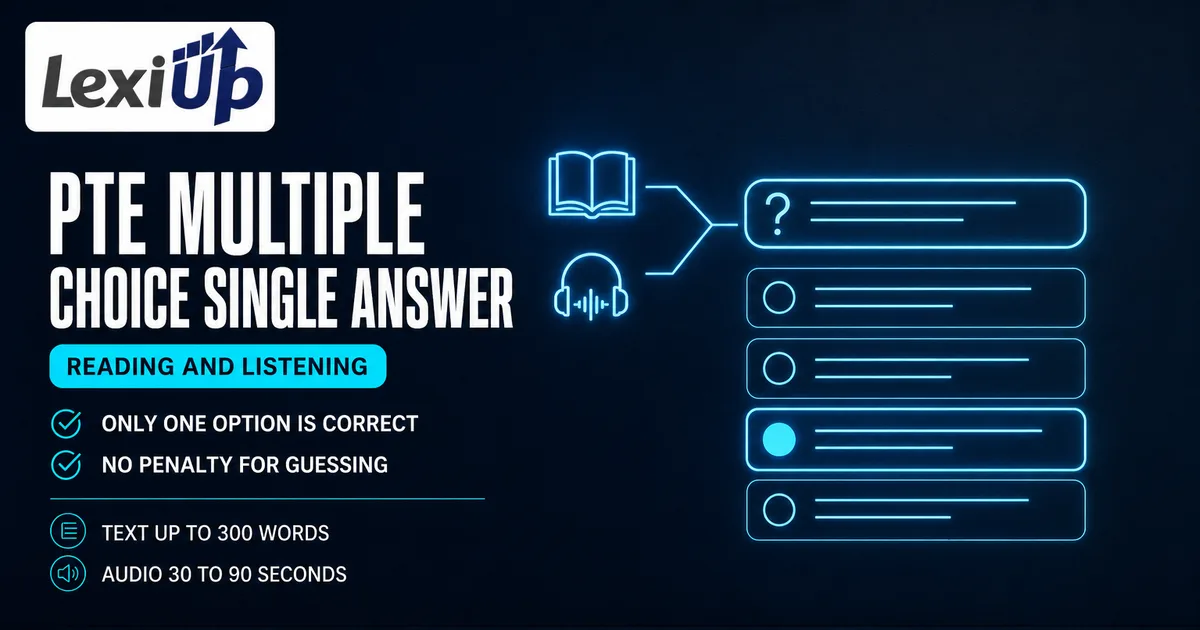
PTE Multiple Choice Single Answer appears in more than one part of the test, and the instruction is the same each time. In PTE Academic Reading, Pearson says that after reading the text you answer a multiple-choice question by selecting one response, working from a text of up to 300 words.
In PTE Academic Listening, you answer the same kind of question after a recording of 30 to 90 seconds. PTE Core also includes it in Reading, where the current page describes answering a question on the content or tone of the text, again selecting only one response.
There are several possible response options and only one is correct. You are not building a set of answers and you are not weighing several partly-right choices against each other. You are finding the single option the text or the recording actually supports.
The scoring is short enough to quote. Pearson states that your response is scored as either correct or incorrect, and that no credit is given for no response or an incorrect response. There is no partial credit, and there is nothing to gain from leaving the question alone.
- Practise Multiple Choice, Multiple Answers →
- See the current PTE Academic test format →
- Compare PTE Core and PTE Academic →
- Build a reading review loop →
- Practise Highlight Correct Summary →
| Where | Task | Length | Scoring |
|---|---|---|---|
| PTE Academic Reading | Answer a multiple-choice question by selecting one response | Text up to 300 words | Correct or incorrect |
| PTE Academic Listening | Answer a multiple-choice question after the recording | Recording 30 to 90 seconds, heard once | Correct or incorrect |
| PTE Core Reading | Answer a question on the content or tone of the text, one response only | Reading section 27 to 37 minutes | Correct or incorrect |
| All of them | Several options, only one correct | No partial credit | No credit for no response or an incorrect response |
The one difference from Multiple Choice, Multiple Answers that changes your behaviour
These two tasks look like siblings and are scored on opposite principles. For Multiple Choice, Multiple Answers, Pearson states that each correct option earns a point and each incorrect option selected loses one, with the item floored at zero. That deduction is what makes a careless extra click expensive there.
PTE Multiple Choice Single Answer has no deduction at all. A wrong answer and a blank answer are worth exactly the same: nothing. Nothing is subtracted for being wrong.
The practical consequence is simple and worth saying plainly. In the multiple-answers task you should only select what you can evidence. In this task you should always select something, every time, even when you are guessing between two options with thirty seconds left.
Carrying the cautious habit from one task into the other is a common and entirely avoidable way to lose marks.
Decision 1: read the question before the text or the recording
The question is short and it tells you what to look for. Reading it first turns a 300-word passage from something to understand into something to search. In the Listening version this matters even more, because the recording plays once and you cannot go back for a second pass.
Do not read the options first. Four plausible options planted in your memory before you meet the evidence will colour everything you then read or hear, and the wording of a distractor is designed to feel right. Read the question, then meet the source, then meet the options.
In the Listening version, use the seconds before the audio begins to read the question and nothing else. Knowing you are listening for a speaker’s purpose rather than a number changes what your attention holds on to from the first sentence.
- Read the question stem first, on its own.
- Do not read the options yet.
- Name what the question wants in one word.
- Only then read the text or listen to the recording.
Decision 2: name what kind of question it is
Questions in this task are not all asking for the same kind of thing, and each kind is answered from a different part of the source. Naming the kind takes two seconds and prevents most wrong answers.
A main-idea question is answered from the whole text or talk, so an option that is accurate about one paragraph is wrong by scope. A detail question is answered from one identifiable place, so the right move is to locate it rather than reason about it.
An inference question asks what follows necessarily from what was stated, not what is likely or reasonable in general. A purpose or tone question asks why the writer or speaker produced this, or how they feel about it, which is carried by word choice rather than by facts.
PTE Core makes this explicit by naming content or tone in its own task description, so a Core question may well be asking how the writer sounds rather than what the writer said. Answering a tone question with a true content statement is a clean way to lose a mark you understood perfectly.
| Kind | Answer comes from | Typical trap |
|---|---|---|
| Main idea | The whole text or talk | An option that is true of only one part |
| Detail | One specific place | A detail from the wrong place, correctly quoted |
| Inference | What must follow from what was stated | Something plausible that was never supported |
| Purpose | Why it was written or said | A summary of content instead of intent |
| Tone | Word choice and attitude | A factually accurate but neutral option |
Decision 3: answer it yourself before you look at the options
Before reading the four options, answer the question in your own words. It does not need to be elegant. A rough half-sentence such as "he thinks the policy worked but cost too much" is enough.
This is a LexiUp practice habit rather than an official Pearson rule, and it exists to protect you from a specific failure. Distractors are written using real language from the source. If you meet them with nothing of your own, the one that reuses the most familiar wording will feel correct.
If you meet them holding your own answer, you are matching rather than being persuaded.
Then find the option closest to what you already said. Usually one is clearly nearer than the rest, and the decision takes moments instead of turning into a long comparison between two options that both sound reasonable.
Decision 4: eliminate on one specific fault
When two options survive, do not ask which one feels better. Ask what is specifically wrong with one of them. A vague preference is a coin toss wearing a disguise; a named fault is a decision.
Most distractors fail in one of a small number of ways. The option may be true but not an answer to the question asked. It may be right about the wrong part of the text. It may overstate a careful claim with a word such as "all", "never" or "proves".
It may reverse a relationship, making the effect into the cause. It may join two things the source never connected.
If you cannot name a fault in either survivor, stop analysing and choose. You have already extracted the value from this item, and the remaining seconds are worth more on the next one than on a tie you cannot break.
- True, but not what the question asked.
- Right idea, wrong part of the text.
- Overstated: all, never, always, proves.
- Reversed cause and effect.
- Two true things joined by a link the source never made.
Decision 5: never leave it blank
Because there is no deduction, an unanswered question is a guaranteed zero and a guess is not. This is the cheapest mark in the whole task and it costs one click.
If the clock is nearly gone, select the option that survived the most of your checks and move on. If you did not get far enough to check anything, still select one. Pearson gives no credit for no response, so an empty option cannot protect a score in the way that caution protects it in the multiple-answers task.
Build the habit in practice rather than trusting yourself to remember it under pressure. A useful rule is to put a provisional answer in as soon as you have read the options at all, and then improve it if time allows. An answer on the screen can be changed; a blank tends to stay blank.
A worked example written for this article
The passage and question below are original teaching material written for this guide. They are not real test content and not official Pearson material. The point is the decision, not the answer.
Suppose a short text explains that a city introduced a cycle-hire scheme, that use rose steadily for two years, and that growth then stopped once the nearest docking stations were consistently full at peak times. The question asks: what does the writer suggest limited the scheme’s growth?
Answer it yourself first: something like "it ran out of capacity where people wanted it". Now the options can be tested. An option saying the scheme was unpopular contradicts the text. An option saying use rose for two years is true but answers a different question.
An option saying cycling is good for cities is a general truth the passage never argued. An option saying demand outgrew the available docking capacity matches what you already said.
Notice that three of those four are defective in different ways, and that naming the fault takes a second once you have your own answer to compare against. Without your own answer, the true-but-irrelevant option is the one most likely to catch you, because every word of it is genuinely in the text.
Same task, two different clocks
In Reading, the text stays on the screen. You can reread, locate, and check, so the discipline is about not drifting: read the question, search with purpose, and resist rereading the whole passage when you only need one place.
In Listening, the recording plays once and lasts 30 to 90 seconds, so the checking has to happen while it runs.
Read the question in the seconds before the audio starts, listen for the answer to that question rather than for everything, and use the note-taking Pearson allows in the Listening section to hold anything you will not remember.
The five decisions do not change between the two. Only the amount of rereading available changes, and knowing that in advance stops the Listening version from feeling like a different and harder task.
Common PTE Multiple Choice Single Answer mistakes
Naming the cause of a wrong answer is what makes review worth doing. "I picked the wrong one" cannot be practised. "I answered a main-idea question with a detail" can be fixed in one session.
| What happened | Real cause | Repair |
|---|---|---|
| Chose the most familiar wording | Met the options with no answer of your own | Answer the question yourself before reading the options |
| Chose a true statement that was not the answer | Question kind not named | Say main idea, detail, inference, purpose or tone first |
| Chose an option about one paragraph | Scope error on a main-idea question | Check the option against the whole source |
| Spent too long on the last two options | Comparing feel rather than naming a fault | Require a specific named fault, or choose and move on |
| Left it blank | Carried caution over from Multiple Choice, Multiple Answers | Remember there is no deduction here, so always answer |
| Missed the answer in the Listening version | Listened for everything | Read the question before the audio and listen for that one thing |
A focused 20-minute session you can repeat
Practising this task badly is easy: answer, check, feel briefly informed, learn nothing. The session below spends most of its time on the part that transfers, which is naming why a distractor attracted you.
- Six fresh items, mixing Reading and Listening.
- Before each one, read the question and name its kind out loud.
- Answer in your own words before looking at the options.
- For every item, write down which option nearly caught you and the specific fault it had.
- Count the faults at the end and find the one that repeats.
- Spend the last five minutes on that fault only, using fresh items.
How LexiUp PTE supports this routine
LexiUp PTE is a preparation app for independent practice and review. For PTE Multiple Choice Single Answer its value is in the last part of that session, where you record the distractor that nearly caught you and watch which fault keeps returning across days rather than within one sitting.
The habits that move this task are unglamorous: read the question first, name its kind, answer it yourself, eliminate on a named fault, and never leave it blank. An app can hold the repetition and the record. The judgement stays yours.
LexiUp PTE does not issue official Pearson scores, and no preparation app can predict one. Use current Pearson pages for task rules, timings and scoring, and recheck them close to your test date, because formats can change.
Frequently asked questions
How is PTE Multiple Choice Single Answer scored?
Pearson states that your response is scored as either correct or incorrect, and that no credit is given for no response or an incorrect response. There is no partial credit.
Do I lose marks for a wrong answer?
No. Unlike Multiple Choice, Multiple Answers, where Pearson states that an incorrect option selected loses a point, this task has no deduction. A wrong answer and a blank answer are worth the same, so you should always answer.
Where does this task appear?
Pearson currently lists Multiple Choice, Single Answer among the PTE Academic Reading question types and the PTE Academic Listening question types, and among the PTE Core Reading question types.
How long is the text or recording?
For PTE Academic Reading the text is up to 300 words. For PTE Academic Listening the recording is 30 to 90 seconds and you hear it once.
Should I read the options before the text?
Read the question first, then the text or recording, then the options. Distractors are built from real wording in the source, so meeting them before you have the evidence makes the most familiar one feel correct.
What does PTE Core ask that PTE Academic does not?
The current PTE Core Reading page describes answering a question on the content or tone of the text. A tone question is answered from word choice and attitude, so a factually accurate but neutral option can still be wrong.
Can I take notes during the Listening version?
Yes. Pearson states that note-taking is allowed in the Listening section. Because the recording plays once, a few words for the answer to the question you already read are usually enough.
Why do I keep narrowing it to two and then choosing wrong?
In PTE Multiple Choice Single Answer this usually means you are comparing which option feels better rather than naming a specific fault in one of them. Requiring a named fault turns a coin toss into a decision.
Does LexiUp give an official Pearson score?
No. LexiUp PTE supports independent preparation and review. It does not issue or guarantee an official Pearson score.
Sources and review note
This guide was reviewed against the sources below. LexiUp remains independent of the exam owners.