For: PTE Academic and PTE Core learners who want a calm method for predicting the ending of a one-play recording
What PTE Select Missing Word practice should train
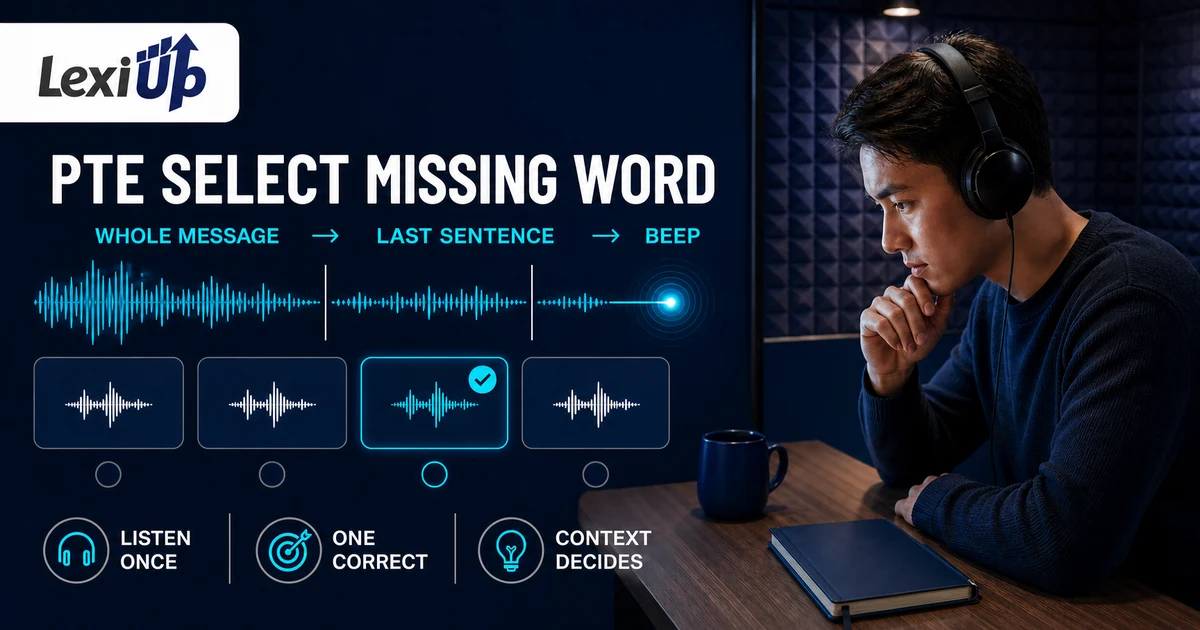
PTE Select Missing Word practice should train prediction from meaning, not a last-second guess. You hear one recording and its ending is replaced by a beep. Your job is to choose the word or group of words that completes the speaker’s message. The answer must fit the topic, the final sentence, and the language immediately before the gap.
Pearson currently uses the task in both PTE Academic and PTE Core. The recording lasts 20–70 seconds, plays automatically, and can be heard only once. There are several options, but only one is correct.
The item has no separate answer timer, and the next recording waits until you select Next, so you can review the options after the audio ends without rushing into the next item.
The response is marked correct or incorrect and affects Listening only. There is no partial credit for eliminating two weak options, and there is no negative marking for a wrong selection.
That scoring makes careful final comparison useful: keep the whole message active, test every option against the ending, and choose one answer rather than leaving the item blank.
- Compare the current PTE Academic test format →
- Check whether PTE Academic or PTE Core fits your goal →
| Feature | Current task detail | Practice decision |
|---|---|---|
| Recording | 20–70 seconds | Follow the whole message, not only the final words |
| Playback | Automatic and once only | Settle before the audio begins and keep listening |
| Gap | Final word or group replaced by a beep | Predict the job of the missing ending |
| Options | Several choices; one correct | Compare every option with the same evidence |
| Scoring | Correct or incorrect | Select the best-supported answer before moving on |
| Skill | Listening | Review meaning, discourse flow, and the final sentence |
Step 1: preview the instructions and options
Before the recording starts, confirm that the item is Select Missing Word. Do not confuse it with Highlight Correct Summary or a listening multiple-choice question. Your target is specifically the missing ending. This simple format check protects attention because you know that the decisive evidence will arrive near the beep while the earlier audio establishes the context.
Skim the response options quickly without trying to solve the item. Notice whether they are single words, short phrases, actions, conclusions, or topic labels. Their grammar and meaning suggest what kind of ending may be required. Keep this preview light; reading every option repeatedly can make you miss the start of the recording.
Use the options to build a listening question, not a preferred answer. Ask, “What is the speaker likely to do at the end?” The recording may conclude, recommend, contrast, warn, give a result, or return to its main idea. Hold those possible functions loosely until the audio provides evidence.
Step 2: follow the whole message
Listen from the first sentence for the topic and purpose. Identify who or what the speaker is discussing, what position or problem is introduced, and whether the talk is explaining, comparing, advising, or describing a sequence. The correct ending usually completes that larger direction rather than introducing an unrelated detail.
Do not write a transcript. A 20–70 second recording moves too quickly for complete notes, and constant writing can hide changes in tone or direction. Keep a small map instead: TOPIC, DIRECTION, and ENDING. Add one or two words under each heading only when they help you remember the relationship.
Track connecting language such as however, therefore, for example, in contrast, finally, and as a result. These signals tell you how the next idea relates to the previous one. A final option may repeat vocabulary from the recording yet still be wrong because it creates the wrong logical relationship.
| Map lane | Question to answer | Useful note |
|---|---|---|
| Topic | What is the talk about? | Two or three content words |
| Direction | What is the speaker doing? | Explain, compare, advise, or conclude |
| Ending | What must the final phrase complete? | Result, action, contrast, or summary |
Step 3: notice the turn into the final sentence
As the recording approaches its end, shift attention from broad topic tracking to the exact direction of the final sentence. Listen for a change in subject, tense, certainty, or purpose. The speaker may move from background to a recommendation, from evidence to a conclusion, or from one example back to the general point.
Keep the previous sentence available because pronouns and references may cross the boundary. Words such as this, these, they, such a change, and that result need an earlier idea to make sense. If an option completes the grammar but gives the reference the wrong meaning, it is not fully supported.
Avoid mentally stopping before the beep. Some learners hear a familiar phrase and decide too early, then miss one contrast word that changes the expected ending. Continue listening until the signal has sounded and the audio is clearly finished. Prediction should remain open until all evidence is available.
Step 4: hold the words around the beep
Give special attention to the final clause and the few words immediately before the beep. Hold their grammar and meaning in short-term memory. Ask what part of speech or phrase type can follow, whether the sentence needs an object or complement, and whether the tone expects a positive, negative, certain, or cautious ending.
Grammar is a filter, not the whole answer. Two options may both fit after the same verb or preposition. The correct choice must also complete the speaker’s idea. Check collocation, reference, and natural sentence structure, but return to the message before selecting.
If the beep replaces a group of words, do not force a one-word prediction. Describe the missing function in plain language: “a recommendation to change,” “the result of the study,” or “a reason the plan failed.” This functional prediction lets you recognise a paraphrased option even when it does not repeat the exact vocabulary you expected.
Step 5: predict before comparing
After the recording ends, pause for a moment and state your own simple prediction before looking closely at the choices. It does not need to match the final wording. A short idea such as “choose another method” or “costs will increase” gives you an independent reference and reduces the pull of an attractive distractor.
Use three checks for the prediction: it follows the whole message, it completes the final sentence, and it sounds like a natural ending. If one check fails, revise the prediction. This takes only a few seconds and turns the item into an evidence decision rather than a contest between familiar-looking options.
Do not try to remember the missing words from recalled test material. The task measures whether you can predict from a new recording. Build practice from authorised audio, original recordings, public lectures with permitted use, or official materials. Keep source notes so your practice library remains honest and reusable.
Step 6: test every option with the same evidence
Compare each option against the prediction and the final sentence. Do not accept an answer because one word appeared earlier in the audio. Repeated vocabulary can make a distractor feel familiar while its meaning, grammar, or discourse function remains wrong. Read the complete option as part of the sentence.
Eliminate by naming the mismatch. One option may fit the topic but not the ending. Another may be grammatical but contradict the speaker. A third may describe a detail rather than complete the conclusion. The strongest answer is the only one that survives all three levels: whole message, final sentence, and local wording.
If two choices remain, compare the exact relationship each creates. Does the sentence need a cause or result, a problem or response, a general point or example? Choose the option that completes the speaker’s route with the least added assumption. The task is not asking which statement is generally true; it asks what completes this recording.
Step 7: select once, review, and move on
Select the best-supported option, then read the completed final sentence once. Confirm that it matches the topic and purpose you heard. Pearson allows you to change the selection before moving on, so correct a clear evidence-based mismatch, but do not cycle through options because of general uncertainty.
The next recording does not begin until you click Next. Use that control to take one calm breath, release the previous item, and reset attention. Do not spend excessive time trying to reconstruct every sentence after the audio has gone. Once the strongest option is selected and checked, move forward.
During practice, record why you changed an answer. Useful labels include “missed contrast,” “forgot final subject,” “picked repeated word,” and “ignored grammar after beep.” This turns review into a precise listening correction rather than a vague instruction to concentrate more.
Use a focused 20-minute practice session
Choose six short authorised or original recordings with clear endings. For the first two, pause before the final phrase and predict freely. For the next two, add three to five answer options. For the final two, use one-play conditions and complete the whole routine without pausing.
Review the evidence, not only the result. A correct answer can come from a lucky guess, while an incorrect answer can reveal a useful near-miss. Write the topic, final-sentence function, your prediction, chosen option, and one reason. Listen again only during review and mark the earliest point where the correct direction became available.
Choose one correction for the next session. If you lost the topic, reduce note-taking. If you missed the final turn, practise discourse signals. If a repeated word attracted you, require a full-sentence check. One observable change is easier to test than a long list of general listening goals.
| Time | Action | Evidence to keep |
|---|---|---|
| 0–4 min | Preview two item endings without options | Your functional prediction |
| 4–9 min | Add options and name each mismatch | Why each distractor fails |
| 9–15 min | Complete two one-play items | Topic, final turn, and selected option |
| 15–18 min | Replay only for review | Earliest usable clue |
| 18–20 min | Choose one correction | A single action for next time |
Diagnose the wrong answer before repeating
Separate attention problems from language problems. If you cannot state the topic, the issue began early. If you knew the topic but not the final direction, you may have missed a connector or reference. If your prediction was sound but the choice was wrong, inspect grammar, collocation, or a subtle difference between two options.
Keep an error log across several recordings. Patterns matter more than one item. You may discover that you stop listening when you see familiar vocabulary, write too many notes, or treat a conclusion as another example. Give each pattern a short label and pair it with one specific drill.
Do not turn home practice into an unofficial score forecast. Use accuracy over a small authorised set to identify a listening habit, not to predict a Pearson result. The purpose of the log is to improve the decision process that can transfer to new audio.
| Observed problem | Cause to check | Next drill |
|---|---|---|
| Topic lost | Too much note-taking | Use only TOPIC, DIRECTION, ENDING |
| Final turn missed | Attention stayed broad | Mark transition words in replay review |
| Repeated word chosen | Familiarity replaced evidence | Require the full-sentence test |
| Grammar mismatch | Prediction stayed too general | Hold the words immediately before the beep |
| Two options feel equal | Relationship is unclear | Name cause, result, contrast, or action |
Build clean practice items without copying test content
Create original recordings from short explanations, public-service information, or your own study notes. Give each recording one clear purpose and a natural final sentence. Replace only the final word or phrase with a tone during practice. Keep a written transcript and source note for review, but hide the transcript during the one-play attempt.
Write three to five options that differ for a real reason. One can repeat vocabulary but break the logic, one can fit the topic but not the final grammar, and one can express the opposite relationship. Avoid random choices that are obviously unrelated. Useful distractors make you compare evidence; weak distractors reward superficial recognition.
Check that exactly one option completes the message naturally. Read the full transcript with each choice and ask another competent English user to review ambiguous items when possible. If two options remain equally defensible, revise the recording or options. Practice should teach a stable decision, not make you guess what the writer intended.
Rotate the discourse function across sessions. Use a conclusion, recommendation, result, contrast, warning, and return to the main idea. Change speakers and topics while keeping the listening process consistent. This variety trains transfer to new audio without using recalled questions, protected assessment material, or an invented Pearson interface.
Keep the audio conditions realistic but usable. Record at normal conversational speed with clear sound, then include mild speaker and topic variety over time. Do not add heavy background noise simply to make an item feel advanced. The practice target is contextual prediction from spoken English, so poor recording quality should not become the hidden test.
Use a final Select Missing Word checklist
Before the audio begins, confirm the task and skim the options lightly. While listening, follow the topic and direction with minimal notes. As the ending approaches, hold the final sentence and listen through the beep before deciding.
After the recording, make a simple prediction and test every option against the same evidence. The correct choice must fit the whole message, the final sentence, and the local grammar. Select one answer, check the completed ending, and move on when the evidence is clear.
Use this checklist to make PTE Select Missing Word practice consistent. The goal is not to guess an exact final word early. It is to understand enough of the recording that one option becomes meaningfully stronger than the others.
- I know the item asks for the missing ending.
- I followed the topic and the speaker’s direction.
- I listened carefully to the final sentence and beep.
- I predicted the function before comparing options.
- I tested grammar, meaning, and discourse flow.
- I selected one answer and checked the completed sentence.
Frequently asked questions
Is Select Missing Word in PTE Academic and PTE Core?
Yes. Pearson currently lists Select Missing Word in the Listening section of both tests. In each version, one recording plays once and the ending is replaced by a beep.
How long is the Select Missing Word recording?
Pearson currently gives a prompt length of 20–70 seconds for both PTE Academic and PTE Core.
How is Select Missing Word scored?
The response is marked correct or incorrect and affects Listening only. No credit is given for an incorrect answer or no response.
Should I listen only to the last sentence?
No. The final sentence is important, but the whole recording establishes the topic, purpose, references, and logical direction needed to predict the ending.
Can I change my answer?
Yes. Pearson says you can deselect an option or choose a different one before clicking Next. Use a clear evidence-based reason rather than changing repeatedly from uncertainty.
Does LexiUp provide an official Pearson score?
No. LexiUp PTE supports independent preparation and review. It does not issue or guarantee an official Pearson score.
Sources and review note
This guide was reviewed against the sources below. LexiUp remains independent of the exam owners.