
For: PTE Academic or PTE Core learners who want smoother, more understandable speaking without memorising complete answers
What PTE speaking fluency practice should improve
PTE speaking fluency practice should make your response easier to follow at a natural, consistent rate. Pearson describes stronger oral fluency through smooth rhythm, phrasing, and stress, while noting that hesitations, repetitions, and false starts can reduce performance. The goal is not maximum speed. It is controlled delivery that supports the content of the task.
Fluency is connected to meaning. A pause after a complete idea can help a listener; a pause inside every short phrase can make the response difficult to process. Clear stress can show which word carries the message. A steady rate gives you time to finish sounds and maintain grammar.
Practising only speed can hide these decisions until a timed response breaks down.
Use the official page for the exact task and test track. PTE Academic and PTE Core share some speaking tasks, but their current inventories, contexts, and timing details are not identical. A good fluency loop keeps the prompt and task rules correct, then changes only one delivery variable at a time.
| Decision | Useful evidence | Unhelpful shortcut |
|---|---|---|
| Rate | Mostly consistent and natural for the speaker | Speak as fast as possible |
| Phrasing | Words are grouped into meaningful units | Pause after every few words regardless of meaning |
| Hesitation | Brief planning does not repeatedly stop the response | Fill every gap with repeated sounds or words |
| Stress and rhythm | Important information is audible and ideas have shape | Give every word equal force |
| Recovery | A small error is corrected without losing the response | Restart the entire answer after one mistake |
Step 1: select the exact task before you record
Begin by naming the test and task: for example, PTE Academic Read Aloud, PTE Core Respond to a Situation, or PTE Academic Summarize Group Discussion. Open Pearson’s current task page and confirm preparation time, answer time, microphone behaviour, and scored traits. This protects your practice from an old timer or a borrowed rule.
Choose a prompt you have not memorised. Familiarity with a task format is helpful, but familiarity with every sentence can create smooth delivery that does not transfer. The prompt should be accessible enough that you can focus on one fluency decision while still requiring real reading, listening, planning, or speaking.
Set one purpose for the recording. You might test phrase grouping in Read Aloud, a calm opening in Respond to a Situation, or transitions between speakers in Summarize Group Discussion. Do not ask one response to prove pronunciation, vocabulary, grammar, content, timing, confidence, and every fluency feature at once.
- Write the track and task name at the top of the practice record.
- Check current timing and microphone instructions on the official page.
- Use a fresh prompt or passage.
- Choose one delivery behaviour to observe.
- Record once before listening or restarting.
Step 2: mark meaningful phrase groups
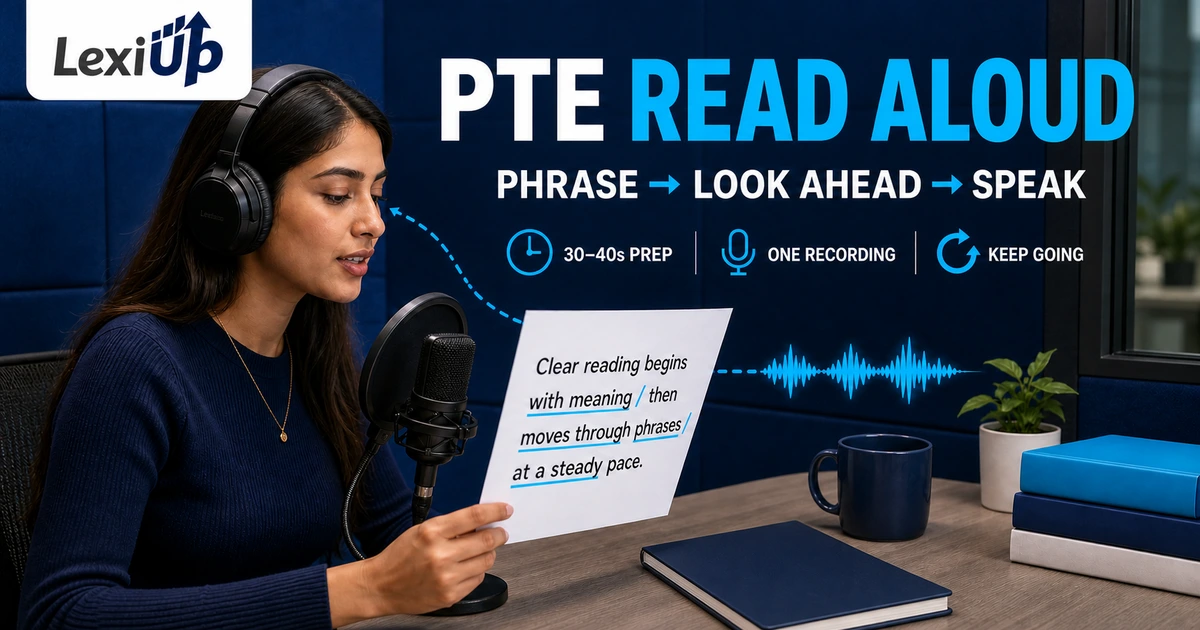
Phrase grouping means speaking words together when they form one meaningful unit. In a Read Aloud passage, a subject and its short verb phrase often belong together. A prepositional phrase or short clause may form another group. In an extended response, each group can carry one part of the message: context, purpose, detail, or requested action.
Mark boundaries lightly with a slash during practice, but do not turn the script into a page of symbols. Read the sentence silently and identify where the meaning changes or expands. Then speak through each short group without inserting a gap between every word. The listener should hear the structure, not the markings.
For tasks without a full written script, plan with keywords in small idea groups. A situation response might use “acknowledge problem / explain impact / request action / close politely.” A discussion summary might use “main topic / speaker one / contrast / shared conclusion.” These groups support natural transitions without becoming a memorised sentence.
| Task | Possible groups | What the groups protect |
|---|---|---|
| Read Aloud | Main clause / supporting phrase / result | Sentence rhythm and breath control |
| Describe Image | Overview / first feature / contrast / closing point | Organisation without listing every detail |
| Retell Lecture | Topic / key explanation / example / significance | Content selection and transition |
| Respond to a Situation | Purpose / relevant detail / action / polite close | Appropriate everyday communication |
| Summarize Group Discussion | Topic / speaker contributions / relationships / conclusion | Accurate synthesis rather than a speaker-by-speaker list |
Step 3: find a natural baseline rate
Record one response at a rate that feels clear, not impressive. Then listen without reading the script. Could you understand each idea on the first pass? Did the response remain stable, or did it accelerate near the end? Did longer words disappear? A natural baseline is the rate at which your content and sounds remain available.
Words per minute can be a rough observation in practice, but it is not a universal target or a Pearson score rule. Different tasks, prompts, speakers, and sentence structures produce different rates. Chasing a number can make a learner rush through punctuation or add unnatural pauses to match a chart. Use intelligibility and consistency as the main evidence.
If your rate changes, locate the trigger. It may be a long noun phrase, an unfamiliar word, uncertainty about the next idea, or awareness of the timer. Rehearse that small section once, then record a new prompt with a similar structure. Repeating the complete memorised response only proves that repetition became familiar.
- Listen once without looking at the script.
- Mark where the rate noticeably speeds up or slows down.
- Identify the language or planning trigger at that point.
- Rehearse the difficult phrase or transition briefly.
- Test the correction on a fresh prompt.
Step 4: reduce disruptive hesitation without filling every silence
A short pause between ideas is different from repeated hesitation inside an idea. Review where silence appears and what caused it. If you paused because the plan ended, improve the keyword map. If you paused before a difficult sound sequence, practise that phrase. If you restarted after a minor grammar error, practise continuing with a simpler repair.
Avoid replacing silence with repeated fillers. A few natural discourse markers may fit an extended everyday response, but automatic “um,” “you know,” or repeated openings can interrupt the message. Build a calm first sentence and a small sequence of ideas so the response has somewhere to go after it begins.
Use controlled recovery. If one word is wrong but the meaning remains clear, continue. If the error changes the main meaning, correct it briefly and move on. Repeatedly returning to the beginning creates more disruption than one imperfect word. This is why one-take recordings are useful: they teach recovery rather than editing.
| Observed pause | Likely cause | Practice response |
|---|---|---|
| Pause before every clause | No phrase-group plan | Mark three or four meaningful groups before speaking |
| Pause at unfamiliar vocabulary | Word retrieval or pronunciation uncertainty | Use a controlled synonym or rehearse the word in a phrase |
| Long pause after the opening | The response has no idea map | Plan purpose, two details, and a close |
| Repeated restart after a small error | Perfection pressure | Practise a brief correction and continue |
| Fast final section | Timer anxiety or overlong plan | Reduce one detail and keep the baseline rate |
Step 5: make pronunciation support fluency
Pearson’s pronunciation guidance centres on being understandable to regular English speakers and recognises regional and national varieties that remain understandable. You do not need to erase your accent. Work on sounds, word stress, and connected speech when they affect meaning or make the listener work harder.
Choose one recurring pattern from the recording. Perhaps final consonants disappear when you speed up, word stress moves to the wrong syllable, or two important words merge. Practise the word alone only long enough to understand the movement, then put it back into the original phrase. Fluency exists across connected language, not isolated sounds.
Record the repaired phrase, then use the same sound or stress pattern in a different sentence. If it stays clear at your baseline rate, the correction is beginning to transfer. If clarity disappears, slow slightly and keep the phrase group intact. Reliable intelligibility is more useful than a fast performance that works only once.
- Choose one sound, stress, or linking pattern that reduced understanding.
- Listen to a reliable model when one is available.
- Practise the word inside a short meaningful phrase.
- Return the phrase to a complete response.
- Test the same pattern in a new sentence after a delay.
Step 6: review one recording in three passes
On the first pass, listen only for meaning. Write the main message you heard. If you cannot recover the intended structure, content planning may be the first repair. On the second pass, mark rate, phrase groups, long pauses, repeated words, and restarts. On the third pass, examine one pronunciation pattern that affected understanding.
Do not transcribe and analyse every sound after every response. Deep review is useful when it produces a clear action; it becomes exhausting when it creates a page of criticism. Save one success, one priority limitation, and one next task. This small record is easy to compare across days.
If using AI feedback, treat it as preparation guidance and check whether the comment matches the recording. A useful comment should point to observable evidence. It is not an official Pearson score, and a generated estimate cannot guarantee an official result. When possible, combine self-review with qualified teacher feedback and official task guidance.
| Pass | Listen for | Record |
|---|---|---|
| 1: Meaning | Main idea, task completion, and understandable sequence | One-sentence summary of what the listener received |
| 2: Fluency | Rate, phrasing, pauses, repetitions, and false starts | One disruption and its location |
| 3: Clarity | A sound or stress pattern that affected understanding | One short phrase to repair |
| Next task | A fresh prompt with a similar demand | Evidence of whether the correction transferred |
Step 7: use near transfer and delayed review
After correcting one response, choose a fresh prompt with a similar speaking demand. If the problem was losing the structure of a situation response, practise another situation with the same four-part idea map. If the problem was phrase grouping in a dense Read Aloud sentence, choose a new passage with a comparable clause pattern.
Near transfer prevents memorisation from looking like fluency. The language changes, so you must retrieve the speaking decision. Keep the correction narrow: the next response does not need to solve every language issue. Compare the same observable feature under the same task conditions.
Return after one or two days and record again without the earlier model beside you. Delayed review shows whether the decision remains available. If it does, maintain it in mixed practice. If it disappears, make the cue simpler: fewer idea groups, a clearer opening, or one pronunciation phrase rather than a complete script.
- Complete one current task under realistic one-take conditions.
- Review it in three passes and choose one priority repair.
- Rehearse only the necessary phrase or planning decision.
- Record a fresh task with a similar demand.
- Repeat after a delay and compare the same feature.
A 20-minute PTE speaking fluency routine
Use the first two minutes to verify the task and choose one fluency focus. Spend three minutes reading or listening to the prompt and making a small phrase-group or idea map. Record once under the current timing. Use five minutes for the three-pass review and one narrow repair.
Record a fresh near-transfer prompt, then write the next review date. If the task requires longer input, adjust the split without removing the correction stage. A complete short session is more useful than several recordings that are never heard again.
Once per week, use a longer mixed set to check whether fluency remains stable when tasks change. Keep task-specific content and form rules active. Speaking smoothly cannot compensate for an irrelevant answer, missing central information, or the wrong response type.
| Time | Action | Output |
|---|---|---|
| 0–2 minutes | Confirm task rules and one focus | A clear observation target |
| 2–5 minutes | Read or listen and plan phrase groups | A small idea map |
| 5–7 minutes | Record once | An honest baseline response |
| 7–12 minutes | Review meaning, fluency, and clarity | One repair supported by evidence |
| 12–18 minutes | Use a fresh near-transfer prompt | A comparable second response |
| 18–20 minutes | Save success, issue, and delayed review | A practical next action |
Common PTE speaking fluency mistakes
Rushing is the most visible shortcut. It often reduces phrase structure, final sounds, and content control. Another shortcut is memorising a complete response. The delivery may sound smooth until the prompt changes, while task relevance and original wording remain weak.
Stopping after every small error also creates unnecessary disruption. Practise brief recovery and continue. At the other extreme, ignoring content to focus only on sound can produce a fluent but incomplete answer. Always check task completion before diagnosing delivery.
Finally, do not compare your accent with one preferred national variety. Use intelligibility, natural phrasing, and the current Pearson criteria as the reference. Progress is visible when a fresh response becomes easier to understand and requires fewer disruptive repairs.
| Shortcut | What it hides | Better action |
|---|---|---|
| Speak as fast as possible | Unclear sounds and broken phrasing | Find a natural consistent baseline rate |
| Memorise a complete script | Weak transfer and possible irrelevance | Use keywords and a flexible idea sequence |
| Restart after every error | Recovery never develops | Correct briefly only when meaning requires it |
| Analyse every weakness at once | No clear practice target | Choose one observable priority |
| Copy one accent | Attention moves away from intelligibility | Practise clear sounds, stress, and rhythm in your own voice |
Final PTE speaking fluency practice checklist
Use this list before saving the session. It does not predict an official score. Its purpose is to confirm that the task was correct, the response was recorded honestly, and the next practice action comes from evidence.
Keep the record small enough to use again. A dated task name, one successful behaviour, one disruption, one repaired phrase, and one near-transfer result can show a pattern more clearly than a long page of general comments.
- I verified the test track, task, timing, and microphone instructions.
- I used a fresh prompt and recorded only once before reviewing.
- My words formed meaningful phrase groups.
- My rate was natural and mostly consistent rather than rushed.
- Pauses supported ideas instead of repeatedly breaking them.
- Pronunciation and stress kept the message understandable in my own accent.
- I reviewed meaning before fluency and fluency before one clarity detail.
- I tested one correction on a fresh prompt and scheduled delayed review.
Frequently asked questions
Does speaking faster improve PTE oral fluency?
Not by itself. Pearson describes stronger fluency through smooth rhythm, phrasing, stress, and a natural consistent rate. Rushing can reduce intelligibility and increase hesitations or false starts.
Do I need a native accent for PTE speaking?
No. Pearson recognises regional and national varieties of English pronunciation when they are understandable to regular speakers. Focus on intelligibility, word stress, phrase grouping, and a stable rate.
How often should I record PTE speaking practice?
A short complete loop can be used regularly: one honest recording, one focused review, one repair, and one fresh prompt. More recordings are useful only when you review them and test a specific change.
Should I memorise PTE speaking templates?
A flexible idea sequence can support organisation, but a complete memorised answer may not fit the prompt and does not prove transfer. Use task-specific keywords and your own relevant wording.
What should I review first in a speaking recording?
Check task completion and meaning first. Then review rate, phrasing, pauses, repetition, and false starts. Finally choose one pronunciation or stress detail that affected understanding.
Is LexiUp speaking feedback an official Pearson score?
No. LexiUp provides independent preparation guidance. AI or self-review feedback is not an official score report, prediction, or guarantee. Use official Pearson sources for current task and scoring information.
Sources and review note
This guide was reviewed against the sources below. LexiUp remains independent of the exam owners.