For: IELTS learners who follow a Part 1 conversation comfortably but lose marks on forms through word limits, plural endings, misheard numbers, or an answer the speaker later changed
IELTS Listening form completion rewards format as much as hearing
IELTS Listening form completion gives you a partly filled form and asks you to write the missing details while the recording plays once. Forms appear most often in the first part of the test, where a conversation covers everyday needs: joining a centre, booking a service, reporting a problem, or registering for a course.
The content is rarely difficult. The marks are usually lost somewhere else, in the gap between hearing the right detail and recording it in the form the question actually allows.
Official IELTS guidance describes Listening as four parts and 40 questions, played once, with the answers following the order of the recording. It also states that spelling and grammar are marked, and that answers going over the stated word limit lose the mark even when the extra word is accurate. Those three facts explain most form completion errors.
A form is a dense, high-speed task with a strict answer shape, so it punishes a routine built only on comprehension.
This guide sets out six practical checks and one original worked form. The centre, the names, the prices, and the spoken lines below were written as teaching material for this article. They are not real test questions and they are not official answers.
Use official IELTS, British Council, IDP, and Cambridge materials for current format and assessment information, and use the checks here to build the answer routine around them.
See an original worked form filled gap by gap
Here is the original teaching form for this article. A caller is enquiring about joining the Hillside Community Sports Centre, and the form has six gaps under the instruction NO MORE THAN TWO WORDS AND/OR A NUMBER. The printed labels read: Surname, Membership type, Start date, Monthly fee, Locker deposit, and Preferred class.
Before any audio plays, those six labels already tell you a great deal. Two gaps want money, one wants a date, one wants a name that will almost certainly be spelled aloud, and two want short noun phrases.
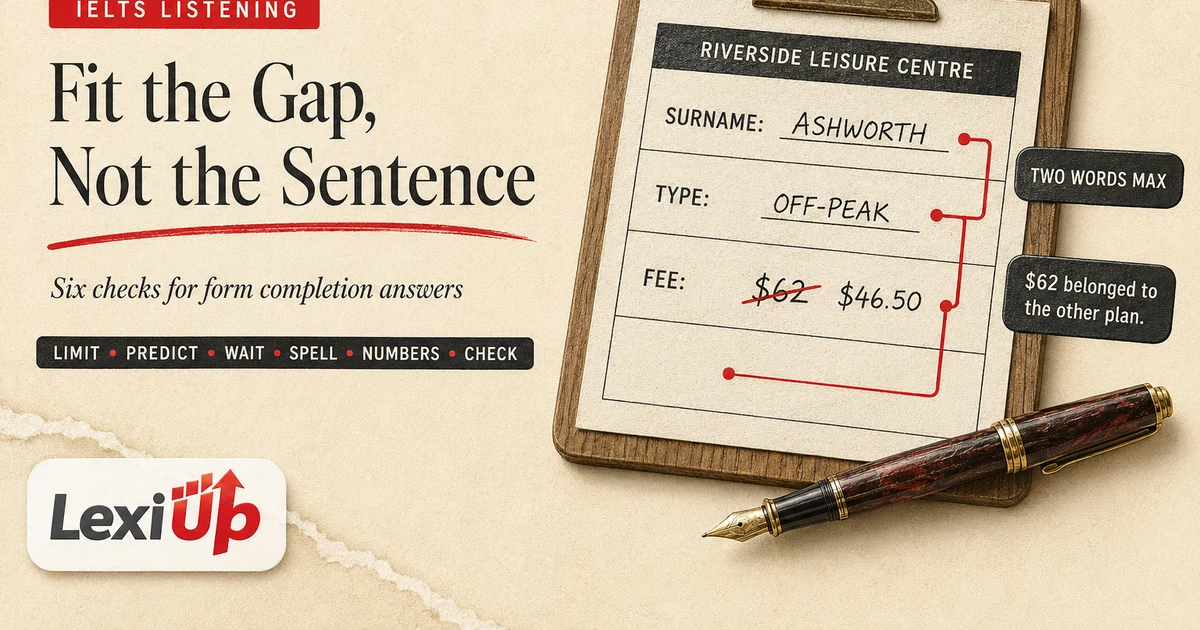
Now the spoken detail, written for this article. The caller says her surname is Ashworth, and spells it A-S-H-W-O-R-T-H. She asks about full membership, is told it costs sixty-two dollars, and replies that she only trains in the mornings, so the assistant moves her to off-peak. Her start date is the fourteenth of March.
The off-peak fee is forty-six dollars fifty. The locker deposit is twenty dollars, refundable. She asks about yoga, then chooses aqua fitness because the yoga class is full.
So the six answers are Ashworth, off-peak, 14 March, $46.50, $20, and aqua fitness. Every one of them fits the limit of two words and a number, and three of them were changed or qualified after the first figure was spoken.
Notice how much of the work happened after the useful word was heard: sixty-two dollars was real but wrong, yoga was mentioned but rejected, and Ashworth is only safe because the caller spelled it out for you.
| Form label | Answer | What decided it |
|---|---|---|
| Surname | Ashworth | Spelled aloud letter by letter, so copy the spelling, not the sound. |
| Membership type | off-peak | The first type named was rejected once the caller described her hours. |
| Start date | 14 March | A date, so a number plus a month fits the stated limit. |
| Monthly fee | $46.50 | The sixty-two dollar figure belonged to the membership she did not take. |
| Locker deposit | $20 | Stated once and never revised; refundable is extra detail, not the answer. |
| Preferred class | aqua fitness | Yoga was asked about, then ruled out because the class was full. |
Check 1: turn the word limit into a mark you can see
Read the instruction before the recording starts and convert it into something visible on the page. For the worked form above, write a small 2+N beside the task. That tiny mark does more than a remembered rule, because it stays in view at the moment the answer arrives and your attention is on the audio.
Learners who lose marks to word limits usually knew the limit; they simply were not looking at it when they wrote a three-word phrase that felt more complete.
The limit also tells you what an answer cannot be. Under two words and a number, refundable locker deposit is impossible, and so is a full sentence explaining the fee. When you can hear a long, tempting phrase and immediately know it will not fit, you stop transcribing and start selecting. That shift is the whole skill.
The form is not asking what the speaker said; it is asking for the shortest accurate filling of that specific gap.
- Mark the exact word and number limit before the audio begins.
- Note that AND/OR A NUMBER usually allows a figure in addition to the words.
- Decide that any answer longer than the limit is wrong, however accurate it sounds.
- Keep the instruction inside your field of view while you write.
- Do not add units, articles, or helpful extra words the label already supplies.
Check 2: read the form’s own grammar before the audio starts
A form is not a list of blanks; it is a small grammatical structure that constrains each answer. A currency symbol already printed beside a gap means you write the figure alone. A label ending in a plural noun signals that a plural answer belongs there.
A gap preceded by an article narrows the answer to a singular noun. Reading these signals during the preparation time turns each blank into a much smaller target before the recording begins.
In the worked form, Monthly fee sits beside a printed dollar sign, so writing $46.50 twice over would be an error and 46.50 alone is what the gap wants. Start date wants a day and a month, not a weekday. Preferred class wants the name of a class, not a sentence about why it was chosen.
None of that requires hearing anything. It is all available in the seconds before the audio, and it removes most of the decisions you would otherwise make under time pressure.
Check 3: predict the answer category, never the answer itself
Prediction on a form means naming the category of information, not guessing the content. Beside each gap, write a one-character symbol: $ for money, D for date, N for a name that will be spelled, P for a place, and C for a category or type.
Five symbols take about fifteen seconds and change how you listen, because your ear is now waiting for a kind of information rather than scanning for anything that sounds important.
Keep the prediction that light. A learner who writes three candidate answers beside a gap starts listening for their own guesses and stops following the speaker.
The symbol does the useful part of the work: when the assistant in the worked conversation says a figure, the $ beside Monthly fee tells you instantly that this is a candidate answer and that you should stay alert for a second figure replacing it. Category prediction sharpens attention; content prediction competes with it.
- Read every printed label on the form during the preparation time.
- Write one symbol beside each gap for the category of answer expected.
- Note which gaps sit next to a printed symbol or unit you must not repeat.
- Listen for information of that category rather than for familiar words.
- Write the first plausible answer and stay ready to replace it.
Check 4: follow the speaker to the final answer, not the first one
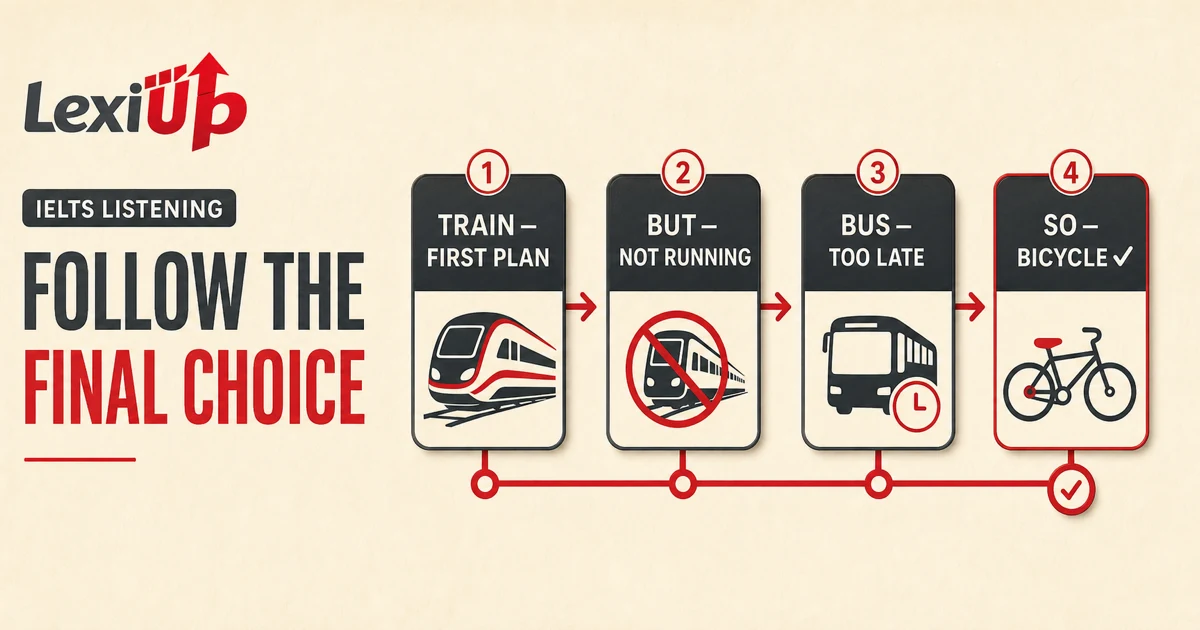
Forms are built for corrections, because the conversations they come from are full of them. A caller states a preference and revises it. An assistant quotes a price for the wrong option. A date is proposed and then moved. In the worked form, two of six answers were replaced mid-conversation and a third was rejected outright.
Treat the first figure you hear as provisional by default, and you will lose far fewer marks than someone who locks it in and moves on.
The signals are ordinary spoken English: but, actually, in that case, sorry, let me check, so that would be. When you hear one, look back at the gap you have just filled rather than forward to the next. Write your first answer clearly enough to be replaced, and do not spend the correction moment rewriting neatly.
The recording continues while you tidy, and a lost place costs more than an untidy answer that you can still read at the end.
Check 5: protect spelling, numbers, and plural endings
When a name is spelled aloud, the letters are the answer and the sound is not. Write the letters as they arrive rather than assembling a word you recognise; Ashworth, Ashwerth, and Ashwoth all sound close at speed, and only the spelled version is safe. The same applies to place names and unusual words.
Official guidance is explicit that spelling is marked, so a correctly understood answer with a wrong letter earns nothing at all.
Numbers need their own habits. Decide in advance how you will write a price, a time, and a date, so you are not inventing a format while listening. Distinguish thirteen from thirty by the stress, and confirm with the surrounding words when a figure is repeated back.
Plural endings deserve the same attention: a gap wanting classes is not satisfied by class. These are small, mechanical repairs, which is exactly why they are worth building into a routine rather than leaving to concentration.
Check 6: review in a fixed order when the part ends
A review works best with a set sequence, because an unstructured reread tends to revisit whichever answer already worries you. Start with blanks, since an empty gap is easier to repair than an answer you have doubted three times. Then check word limits, then numbers and dates, then spelling and plural endings, then question-number alignment.
That order handles the fastest, most mechanical errors first and leaves genuine uncertainty until last.
Resist the pull to change a confident answer without new evidence. If you wrote off-peak because the caller described morning training, that reasoning does not weaken because you are now nervous. Change an answer when you can name what you heard that contradicts it, and leave it alone when you cannot.
For paper practice, rehearse the transfer to the answer sheet as part of the task; for computer practice, use the platform’s review time on the answers you have already entered.
| Order | What to check | Typical repair |
|---|---|---|
| 1 | Blanks | Fill from the category symbol and the surrounding labels. |
| 2 | Word limits | Cut the answer to the shortest accurate version. |
| 3 | Numbers and dates | Confirm the format and the decimal or month. |
| 4 | Spelling and plurals | Check spelled names letter by letter and check endings. |
| 5 | Alignment | Confirm each answer sits beside the label it belongs to. |
Build an error map from your IELTS Listening form completion practice
After you mark a practice form, label every wrong answer with one cause rather than counting a score. Useful labels are over the word limit, spelling, plural ending, number format, replaced answer missed, wrong gap, and not heard. Choose the first cause you could realistically repair.
Only the last label points at listening comprehension; the rest point at the answer routine, and they are repaired by different work.
The pattern tells you what to practise next. A page of word-limit and spelling errors means another full Listening test is a poor use of an hour, because the comprehension is already there. A short completion drill with a deliberate two-minute check will move more marks.
Errors clustered on replaced answers point instead at correction tracking, so choose material where speakers revise details and practise waiting for the final version before committing.
Practise the routine before you need it
LexiUp IELTS is one way to keep this routine in one place between practice tests. It is free to start and has been ad-free since version 1.0.10, so a short Listening drill is not interrupted partway through.
Its AI feedback returns up to five successful results in any rolling twenty-four hours, which suits this kind of work well: one form, one honest review of the causes, and one specific repair to carry into tomorrow rather than a long undirected session.
Two limits are worth stating plainly. LexiUp IELTS is an independent preparation app and is not an official IELTS service, and its band estimates are practice guidance rather than examiner scores.
Use it to shorten the distance between noticing an error and drilling it, and use the official sources below for anything about test format, booking, or how the test is actually assessed.
Keep the checks small on test day
Test day is not the moment to add a technique. Use the checks you have already rehearsed: mark the limit, read the form’s grammar, predict the category, wait for the final answer, protect spelling and numbers, and review in a fixed order.
Familiar actions survive nerves, and a form is short enough that a steady routine carries you through it before there is time to worry about the recording.
If a gap defeats you, write the most plausible answer of the right category and move on immediately. An unanswered gap and a wrong gap score the same, and the next answer is arriving whether or not you are ready for it.
One lost detail costs one mark; losing your place on the form can cost several, and that is the error worth guarding against most carefully.
Frequently asked questions
How many words can I write in IELTS Listening form completion?
Only as many as the printed instruction allows. A common limit is no more than two words and/or a number. Official IELTS guidance states that an answer over the stated limit loses the mark, even when the extra word is accurate.
Do I need to write the currency symbol or unit in a form gap?
Not when the form already prints it. If a dollar sign or a unit appears beside the gap, write the figure alone. Repeating a symbol the form supplies can push the answer outside the permitted form.
What should I do when the speaker changes an answer?
Replace it, but only on clear evidence. Words such as actually, but, or in that case usually signal a revision. Write your first answer so it can be crossed out easily, and confirm the final version before the conversation moves to the next gap.
Does spelling matter if the examiner can tell what I meant?
Yes. Official IELTS guidance states that spelling and grammar are marked in Listening. When a name is spelled aloud in the recording, copy the letters exactly rather than writing the version you think you recognise.
Sources and review note
This guide was reviewed against the sources below. LexiUp remains independent of the exam owners.