For: IELTS Academic and General Training learners who lose Reading marks on matching information tasks by choosing a paragraph that repeats a keyword instead of the one that states the exact detail
Use IELTS Reading matching information to find specific detail
IELTS Reading matching information questions ask you to find the paragraph that contains a specific piece of information. The task gives a list of statements and a passage with lettered paragraphs. Your job is to decide where each detail actually appears. It does not test whether the statement is true or false.
It tests whether you can locate exact information quickly and accurately.
This question type is different from matching headings. Matching headings asks for the main idea of a whole paragraph, so the best answer represents the entire paragraph. Matching information asks only where one detail is stated, even when that detail is a small part of a longer paragraph.
Reading for the general topic is not enough; you have to find the sentence that states the specific fact.
This guide gives you six practical location steps built around one original worked example. The example passage and questions are learning material written for this guide. They are not real exam questions or official answers. The aim is a repeatable routine you can apply to any matching information set during focused practice.
See one question as a specific detail search
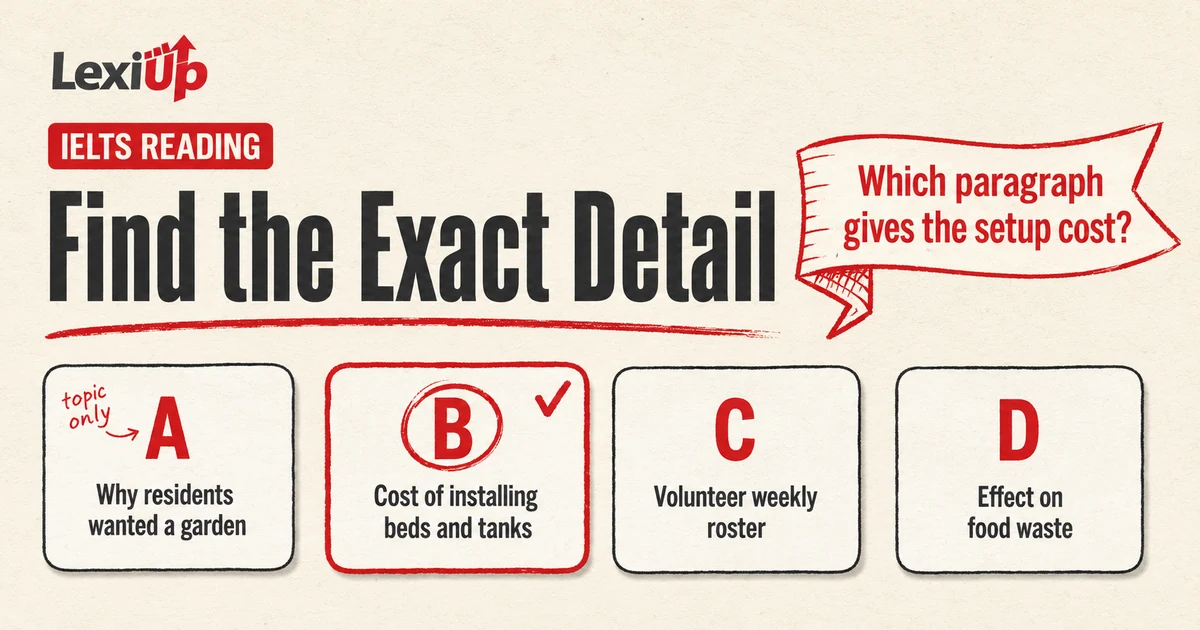
Consider a short original passage about rooftop community gardens with four paragraphs. Paragraph A introduces why residents wanted a shared growing space. Paragraph B describes the building survey and the cost of installing raised beds and water tanks. Paragraph C reports how volunteers organised a weekly roster. Paragraph D explains the effect on food waste and neighbourhood contact.
Now take one question: which paragraph mentions the cost of setting up the garden equipment? The word cost points to money and installation. Paragraph A gives the motivation, so it is a topic match, not a detail match. Paragraph D discusses results.
Only paragraph B states the expense of installing beds and tanks, so B is the correct answer for that detail.
The worked example shows the core habit. The claim in the question is a specific detail. The reason a paragraph matches is that it states that exact detail, not merely a related topic. The example of a trap is paragraph A, which repeats the word garden.
The result is a confident choice of paragraph B because it holds the precise information the question requests.
| Paragraph | What it states | Match for the cost question |
|---|---|---|
| A | Why residents wanted a garden | Topic only, not the detail |
| B | Survey and cost of installing beds and tanks | Correct: states the exact detail |
| C | Volunteer weekly roster | Unrelated detail |
| D | Effect on food waste and contact | Result, not the setup cost |
Step 1: read the question detail before you scan
Start with the statement, not the passage. Read each matching information question and decide exactly what detail it names. Underline the concrete part: a number, a reason, a comparison, a process, an example, a definition, or a named thing.
The clearer your target, the faster your search, because you are looking for one specific idea rather than a general subject.
Watch for the type of information the question wants. Words such as cost, cause, comparison, first, benefit, or method tell you what a matching paragraph must actually contain. A paragraph that mentions the topic but not that specific element is not the answer.
In IELTS Reading matching information, the exact element in the statement is the thing you must find in the text.
Keep the questions in your own words. Rephrase each statement as a short search question. Instead of holding the full sentence in mind, ask a compact question such as “where is the setup cost?” or “which part gives a reason for the change?” A short question is easier to carry through several paragraphs without losing the detail.
- Read the statement and underline the concrete detail.
- Name the information type: cost, cause, comparison, method, or example.
- Rewrite the statement as a short search question.
- Ignore the general topic and keep only the specific target.
Step 2: turn the detail into search anchors
An anchor is a word or idea that is easy to spot while scanning. Strong anchors are specific: numbers, dates, names, places, and unusual nouns. These stand out from the surrounding text and lead you to the right area quickly. Weak anchors are common words that appear across many paragraphs, so they cannot separate one paragraph from another.
Prepare for paraphrase. The passage rarely repeats the exact words of the statement. A question about cost may appear as expense, price, or the phrase spent on installation. A question about a reason may appear as because, led to, or resulted from.
Anchor on the meaning as well as the word, so a synonym does not hide the correct paragraph from you.
Hold two or three anchors, not the whole sentence. If the statement mentions the cost of installing equipment, your anchors might be money words and installation words. When a paragraph contains both, slow down and read it closely. When it contains only one common word, keep moving and test the next likely paragraph instead.
- Strong anchors: numbers, dates, names, places, and technical nouns.
- Meaning anchors: cause, comparison, change, cost, and purpose.
- Synonym watch: expense for cost, method for way, benefit for advantage.
- Weak anchors: broad words that appear in most paragraphs.
Step 3: scan paragraph by paragraph, not word by word
Matching information answers are not in passage order, so you cannot rely on the sequence of questions. Instead, work in controlled sweeps. Move your eyes across each paragraph looking only for your anchors. You are not reading for full understanding yet; you are checking whether this paragraph could contain the specific detail the statement names.
When a paragraph shows an anchor, pause and read those one or two sentences carefully. If they state the detail, mark the answer. If they only mention the topic, note the paragraph as a possible trap and continue. This two-speed method, fast scan then slow check, keeps you moving while still testing the exact information before you commit.
Track paragraphs you have cleared. A light tick beside a paragraph you have already searched stops you from re-reading it for every question. This simple record saves time across a full set of statements, because matching information sets often send you back to the same passage many times for different details.
Step 4: confirm the whole detail, not one keyword
The most common error is choosing a paragraph because it repeats a word from the statement. A shared keyword shows you where to read, not which answer to choose. Before you commit, check that the paragraph states the complete detail, including any number, reason, comparison, or condition that the statement contains.
Test the match with a direct question. If the statement is about the cost of equipment, ask whether the paragraph actually gives a cost or expense for that equipment. If it only says the equipment existed, the detail is missing and the paragraph is a trap. A confirmed match answers your search question fully, not partly.
Separate a near match from the real one. Two paragraphs may both mention the garden, yet only one states the setup cost. When you feel unsure between two options, write a tiny note such as “A mentions garden; B gives the price”. The paragraph that supplies the exact element named in the statement is the answer.
| Statement element | Weak evidence | Confirmed evidence |
|---|---|---|
| A cost | Equipment is mentioned | A price or expense is stated |
| A reason | The topic appears | A cause or because link is given |
| A comparison | Two things are named | One is measured against the other |
Step 5: handle paragraphs used once, more than once, or not at all
Read the instructions for each set with care. Some matching information tasks say that any letter may be used more than once, and some say a paragraph may not be used at all. These rules change your strategy. If a letter can repeat, finding one detail in a paragraph does not remove it from later questions.
Do not force every paragraph to hold an answer. When the instructions allow unused paragraphs, some letters will simply not match any statement. Trying to place a detail in every paragraph creates errors. Choose a letter only when that paragraph clearly states the specific information, and leave paragraphs unmatched when the detail is genuinely absent.
Answer the confident questions first. Some details, especially numbers and names, are easy to locate. Place those answers, then use the remaining letters to narrow the harder questions. Removing what you already know reduces the search space for the details that take longer to confirm, which protects your accuracy under time pressure.
- Check whether letters can be used more than once.
- Check whether some paragraphs may be unused.
- Place easy number and name details first.
- Leave a statement unmatched only after a careful search.
Step 6: mark, skip, and return under time pressure
Set a soft limit for each question. If you cannot confirm a detail within a reasonable search, mark the statement, write your two best paragraph options beside it, and move on. A single hard question should not consume the time you need for several easier ones later in the passage.
Return with fresh anchors. When you come back to a marked question, change your search words. If cost did not lead you to the paragraph, try expense, budget, or the amount spent. A different anchor often reveals the paraphrase you missed on the first sweep, and the correct paragraph then becomes clear.
Protect the final minutes for transfer and review. Make sure every statement has a letter, because an unmarked answer scores nothing. Recheck any question where you guessed between two paragraphs, and confirm that your letters are written in the correct boxes. Careful transfer preserves the marks your searching has already earned.
- Set a soft time limit for each statement.
- Mark hard questions and record two candidate letters.
- Return later with new synonym anchors.
- Confirm every statement has an answer before time ends.
- Recheck guesses and verify accurate transfer.
Avoid the four traps that cause matching information errors
Distractor paragraphs are written to share vocabulary with the statement. A paragraph can repeat the topic word several times and still never state the specific detail the question names.
IELTS Reading matching information rewards the reader who checks the exact fact, so treat a familiar word as a signal to read closely rather than as proof that you have already found the answer. The repeated word marks the neighbourhood, not the address.
Partial matches are the second trap. A statement can join two ideas, such as a cost and the reason behind it. A paragraph that gives the cost but not the reason answers only part of the detail.
Unless one paragraph contains the complete information, keep searching, because the correct letter has to cover every element of the statement you underlined, not just the part that was easiest to find.
Prior knowledge is the third trap. You may know facts about the topic from outside the passage, but only the text can decide the answer. If a statement describes a benefit that the passage never mentions, no paragraph matches it through your own experience.
Stay inside the passage and let the printed detail, not your background knowledge, choose the letter for each question.
Order expectation is the fourth trap. Because several Reading tasks follow the passage sequence, learners often assume matching information does the same. It does not. The detail for question one may sit in the final paragraph, and the detail for question two may sit near the start.
Search by anchor and confirmed evidence, and let the passage, not the question order, place each answer.
- Keyword trap: the paragraph repeats a word but not the detail.
- Partial trap: only one part of a two-part statement is covered.
- Knowledge trap: the answer is supplied from outside the passage.
- Order trap: expecting answers to follow the question sequence.
Practise IELTS Reading matching information with one passage
Choose one practice passage with a matching information set. Work through the six steps in order: read the detail, build anchors, scan in sweeps, confirm the whole detail, apply the repetition rule, and manage your time. Do not rush to the answer key. The value is in the routine you repeat, not in one lucky match.
Review by cause, not by score. For every question you missed, write why: a weak anchor, a paraphrase you did not expect, a keyword trap, or a partial match accepted too early. Keep short evidence such as “chose A for the word garden; B stated the cost”.
These specific notes tell you what to change in your next attempt.
LexiUp IELTS can help you place short Reading practice inside a daily plan and return to saved mistakes on iPhone. The app is free to start and supports independent preparation. LexiUp is not affiliated with or endorsed by IELTS, and its feedback is not an official band score.
Use current official IELTS materials to confirm the test format and question instructions.
| Step | Question | Evidence to keep |
|---|---|---|
| 1. Read | What exact detail does the statement name? | The underlined target |
| 2. Anchor | Which specific words will I scan for? | Two or three strong anchors |
| 3. Scan | Which paragraphs show an anchor? | A shortlist to check |
| 4. Confirm | Does the paragraph state the whole detail? | Complete, not partial, evidence |
| 5. Rules | Can letters repeat or stay unused? | The instruction applied |
| 6. Time | Did every statement get an answer? | One repair note for next time |
Frequently asked questions
How is IELTS Reading matching information different from matching headings?
Matching information asks where one specific detail is stated, even if it is a small part of a paragraph. Matching headings asks for the main idea of a whole paragraph. One is a detail search; the other is a summary of the entire paragraph.
Are matching information answers in the same order as the passage?
Usually not. Unlike some Reading tasks, matching information answers can come from any paragraph in any order. Scan each paragraph for your anchors rather than expecting the answers to follow the sequence of the questions.
Can one paragraph be the answer to more than one question?
Sometimes. Read the instructions, because some sets state that any letter may be used more than once. When repetition is allowed, finding one detail in a paragraph does not remove that paragraph from later questions.
Why do I keep choosing a paragraph that only repeats a keyword?
A shared keyword shows where to read, not which answer to choose. Confirm that the paragraph states the complete detail, including any number, reason, or comparison, before you commit to that letter.
How should I manage time on matching information questions?
Set a soft limit for each statement, mark hard questions with two candidate letters, and return later with new synonym anchors. Make sure every statement has an answer, because an unmarked question scores nothing.
Sources and review note
This guide was reviewed against the sources below. LexiUp remains independent of the exam owners.