
For: IELTS learners practising Reading completion questions
IELTS Reading instruction word limits are part of the question
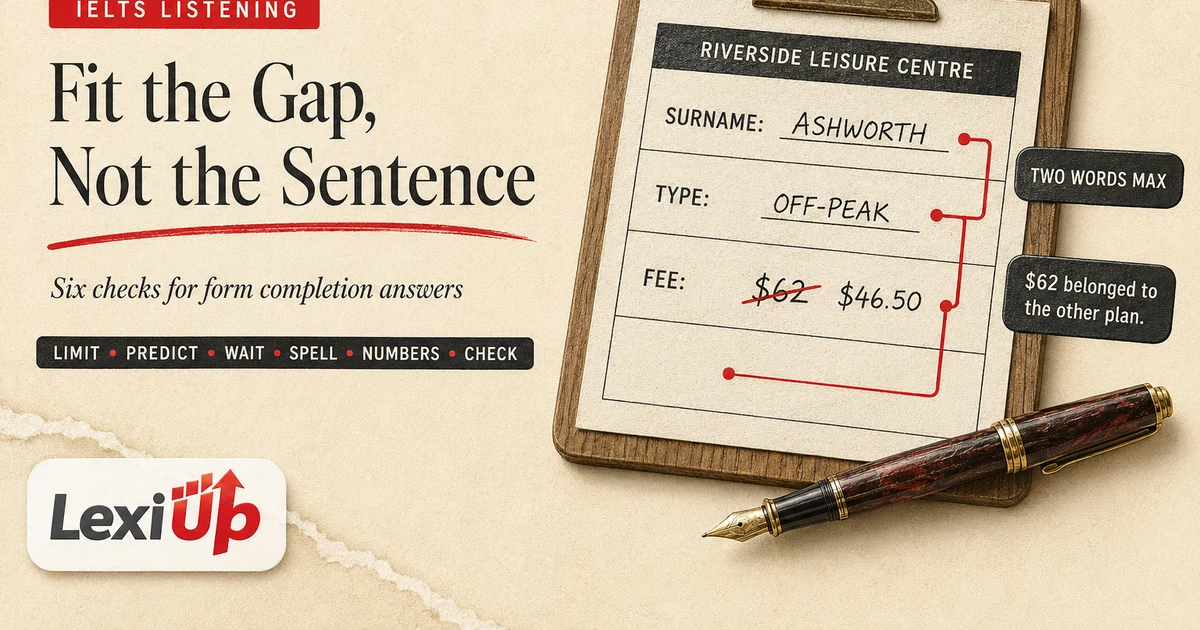
IELTS Reading instruction word limits tell you how much of an answer you may write. In completion tasks, the instruction may allow a set number of words, a number, or words and a number. Official IELTS guidance states that you lose the mark when you write more than the stated limit, even if the extra words seem helpful.
This means the instruction is not separate from comprehension. You need the right information in the allowed form. A calm routine checks the limit before reading, predicts the answer type, copies only what is needed, and reviews the final form. This guide explains that routine without reproducing protected test questions.
Check 1: read and restate the instruction first
Before searching the passage, circle the exact limit. Restate it in a tiny note such as “up to two words” or “one word and/or a number”. Do not rely on the instruction from the previous question set because limits can change within the same Reading test.
Also notice the answer method. Some tasks require words from the passage. Others require a letter, a heading number, or a choice from a list. Writing a word when the task asks for a letter is an answer-form error, even if you understood the text. Keep the task instruction visible while you work.
- Underline the maximum number of words.
- Notice whether a number is allowed or required.
- Check whether words must come from the passage.
- Confirm whether the response should be words, a letter, or another option.
- Repeat the check when a new question set begins.
Check 2: use the sentence grammar to predict the answer form
Read the words around a gap before locating the answer. An article may suggest a singular countable noun. A plural verb may suggest a plural subject. A preposition can indicate the kind of phrase that fits. This prediction helps you select the smallest grammatically complete answer.
Do not force the passage wording into the gap without reading the completed sentence. The question may paraphrase the text, and the chosen words still need to fit the question grammar. After inserting the answer, read the whole sentence once. If it is ungrammatical, check the passage and instruction again.
Check 3: count only the words you need
When the passage contains a longer phrase, identify which part answers the question. Extra adjectives, articles, or nouns may push the response over the limit. Do not add an explanation, unit, or label unless the question and source make it necessary. The answer box is not a place to show all the evidence you found.
Official IELTS format guidance notes that hyphenated words count as single words. Numbers may be written as figures or words. These details matter, but they should not encourage complicated answers. When two forms seem possible, choose the form that is supported by the passage, fits the grammar, and stays safely within the stated limit.
| Instruction pattern | What it allows | What to check |
|---|---|---|
| No more than one word | Zero extra words beyond one required word | Do not copy an unnecessary article or adjective. |
| No more than two words | One or two words | Choose the shortest complete phrase supported by the text. |
| One word and/or a number | One word, one number, or one word plus one number | Check whether a unit is already printed beside the gap. |
| Choose a letter | The requested option label | Write the letter rather than copying the full option. |
Check 4: copy spelling, number form, and plurals carefully
A located answer still needs accurate spelling. When the answer comes from the passage, copy it carefully. Compare letter order, singular or plural form, and any hyphen. If a number is involved, check the digits, date, decimal, or unit against the text and the words already printed in the question.
Grammar around the gap can reveal a missing plural ending, but the passage remains the evidence. Avoid changing a word because another form sounds more natural to you. Completion questions usually require precise information, so use the text and instruction together.
Check 5: run a focused final review
Do not reread the entire passage for every answer. Review the answer boxes and instructions first. Check for blanks, answers over the limit, incorrect letters, spelling, plural endings, and repeated answers that look suspicious. Then return to the passage only where the review finds a clear risk.
Protect review time by using a move-on rule during practice. If one item is consuming too long, mark it, make the best evidence-based choice you can, and continue. The Reading test gives 60 minutes including answer transfer, so a final answer-form check must fit inside your timing plan.
- Scan every question-set instruction again.
- Count the words in completion answers.
- Check spelling, plurals, hyphens, and number form.
- Confirm that letter-answer tasks contain letters.
- Return only to marked items with a specific concern.
Review word-limit errors by cause
Separate an instruction error from a comprehension error. If you found the correct phrase but copied three words into a two-word answer, practise reading limits before searching. If you selected the wrong part of the phrase, practise grammar prediction and local evidence. If spelling changed, use a careful copy-and-check routine.
Write one short correction rule and test it on a new item. “Read the limit first” is useful only when you actually do it before the next set. A fresh question shows whether the routine has changed, while repeating the original answer may only test memory.
Practise instruction checks with LexiUp IELTS
LexiUp IELTS can support Reading practice and mistake review on iPhone. Make the IELTS Reading instruction word limits check your first action in every relevant task. After correction, label whether the issue came from evidence, instructions, grammar fit, spelling, or timing, then choose a related practice item.
LexiUp is an independent preparation app and is not affiliated with IELTS. Its estimates are not official band scores. Use official IELTS format guidance for the test rule, then use LexiUp to practise applying that rule consistently.
Frequently asked questions
What happens if I exceed an IELTS Reading word limit?
Official IELTS guidance states that you lose the mark when you write more than the stated limit. Read the instruction again whenever a new question set begins.
Does a hyphenated word count as one word in IELTS Reading?
Official IELTS format guidance states that hyphenated words count as single words. Copy the answer carefully and follow the exact instruction for the task.
Can I add an article to make an IELTS Reading answer grammatical?
Only add words that the instruction allows and the answer requires. Read the complete question sentence and use the passage wording, grammar, and limit together.
Do IELTS Reading word limits apply to every question type?
No. They apply where the instruction states a word or number limit. Other tasks may require letters, headings, or selected options, so follow each question set separately.
Sources and review note
This guide was reviewed against the sources below. LexiUp remains independent of the exam owners.